
TrueCare RCM provides specialized pain management billing services for physicians, interventional pain clinics, and multi-provider practices across the United States. We support procedure coding, insurance claims, prior authorizations, denial management, and A/R follow-up. Contact our team today to discuss your practice’s billing needs.
Specialized Medical Billing & Coding for Pain Practices
Pain Management Billing Services for Clinics & Specialists

Interventional Pain Management Billing & Coding Services
Interventional pain management billing requires careful review of procedure documentation, medical necessity, coding guidelines, and payer-specific coverage requirements.
TrueCare RCM supports pain management practices with billing workflows designed for procedure-based care, helping teams review claim information, identify potential coding issues, and manage payer follow-up.
Epidural steroid injection claims require accurate documentation of the procedure performed, anatomical region, diagnosis, and relevant clinical details. Our billing workflow includes reviewing applicable coding and payer requirements before claim submission.
Facet joint interventions and medial branch blocks can involve specific rules concerning spinal regions, treatment levels, laterality, and documentation. Careful claim review helps identify inconsistencies and potential coverage issues.
Radiofrequency ablation claims require attention to documented treatment levels, laterality, procedural details, and applicable payer coverage policies. We support coding and claim review based on the services documented.
Different nerve block procedures involve different coding and medical necessity considerations. Our billing support focuses on complete claim information, accurate documentation review, and applicable payer requirements.
Spinal cord stimulation may involve trial services, implantation procedures, device-related billing, and follow-up care. These services can have distinct authorization, coding, and documentation requirements.
Pain practices benefit from organized processes for procedure documentation, claim submission, payment posting, and denial follow-up.
TrueCare RCM helps coordinate these billing activities to support accurate claim processing and better visibility into outstanding reimbursements.
Prior Authorization & Payer Requirements for Pain Procedures
Pain management billing involves varying insurance requirements depending on the procedure, diagnosis, payer, and patient’s benefit plan.
An organized authorization and documentation workflow helps practices identify potential billing issues before claims are submitted.
Accurate preparation and ongoing payer follow-up can help practices manage these requirements, although authorization approval does not guarantee reimbursement.

Common Pain Management Billing Denials & How We Address Them
Pain management claims can be delayed or denied because of missing authorizations, documentation gaps, coding inconsistencies, medical necessity requirements, and payer coverage limitations.
The appropriate response depends on the payer’s stated denial reason, the supporting medical record, and the applicable appeal or correction process.
Incomplete treatment histories, unsupported diagnoses, or missing procedure details may result in coverage-related denials.
Our billing approach includes reviewing the available information, identifying documentation issues, and coordinating appropriate follow-up with the practice.
Some interventional pain procedures require approval before treatment. Claims may encounter payment issues when authorization information is missing, incorrect, expired, or inconsistent with the service performed.
We support authorization-related billing reviews and follow-up when included in the agreed workflow.
Incorrect procedure codes, diagnosis mismatches, unsupported modifiers, or inaccurate procedure details can result in rejections, denials, or payment discrepancies.
Coding review helps identify potential errors using the documented service and applicable payer requirements.
Certain procedures are subject to coverage restrictions or limitations on treatment frequency.
Reviewing payer policies and supporting documentation helps determine whether a claim requires correction, additional information, or an appropriate appeal.
Pain practices may experience unpaid claims, delayed payer responses, or reimbursement discrepancies.
We help review outstanding balances, payment information, denial reasons, and payer status to identify appropriate follow-up actions.
Our workflow focuses on identifying the issue, reviewing available claim information, coordinating necessary corrections or appeals when appropriate, and monitoring the account until the next action is resolved.
We also look for recurring denial patterns that may indicate opportunities to improve registration, documentation, authorization, or billing processes.
Our Pain Management Revenue Cycle Services
TrueCare RCM supports pain management practices with coordinated medical billing, coding, claim submission, reimbursement follow-up, and reporting services.
Our workflows can be adapted to the procedure mix, payer requirements, and operational needs of your practice.
Need credentialing support too? TrueCare RCM also offers pain management credentialing and payer enrollment services, including assistance with provider applications, revalidation, and enrollment tracking. These services can be coordinated with billing support when included in your engagement.
Why Choose TrueCare RCM for Pain Management Billing?
Choosing a pain management billing company means finding a partner that understands procedure-based claims, insurance requirements, and the administrative challenges faced by specialty practices.
TrueCare RCM provides coordinated medical billing and revenue cycle support designed around the needs of interventional pain physicians, clinics, and multi-provider practices.

Procedure-Specific Billing Knowledge
We focus on billing workflows involving injections, nerve blocks, radiofrequency ablation, and other supported pain management services, with attention to documentation and payer requirements.
Payer-Focused Claim Reviews
Our billing process includes reviewing relevant coding requirements, claim information, payer responses, and documentation issues that may affect reimbursement.
Denial Management & A/R Follow-Up
We help practices identify claim problems, monitor outstanding balances, and coordinate appropriate corrections, appeals, or payer follow-up.
Support Tailored to Your Practice
Service responsibilities can be adapted to your practice’s size, procedure mix, existing systems, and operational priorities.
Clear Financial Reporting
Reporting helps practice administrators review claim activity, denial patterns, payment posting, and outstanding insurance balances.
Billing & Credentialing Coordination
For practices requiring both services, pain management billing can be coordinated with provider credentialing and payer enrollment support when included in the agreed scope.
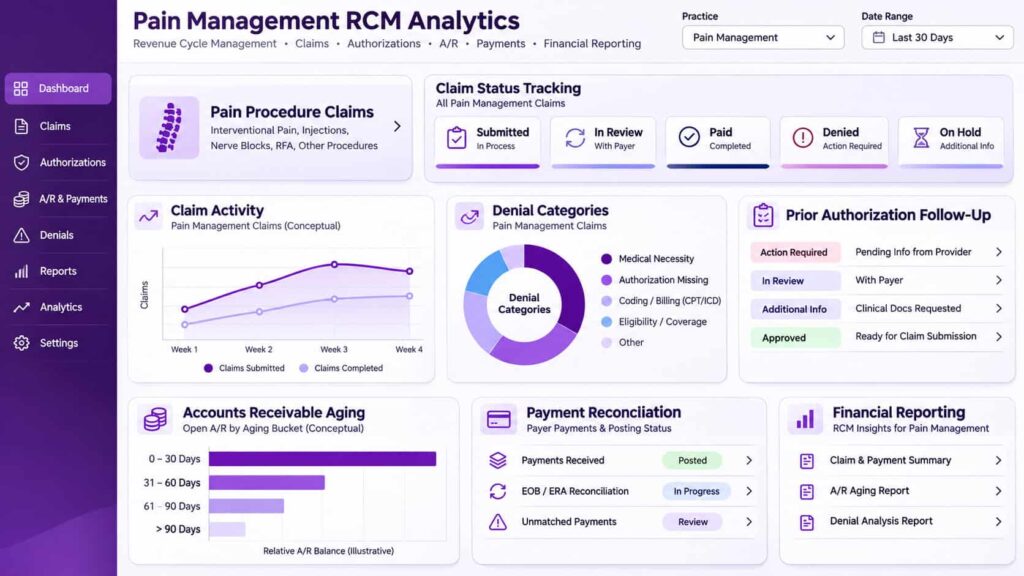
Pain Management Billing Performance & Reporting
Pain management practices need visibility into outstanding claims, payer denials, payment activity, and reimbursement delays.
TrueCare RCM supports financial monitoring through reporting and follow-up workflows appropriate to the services included in the engagement.
Clear reporting helps your practice understand financial activity and prioritize billing issues without relying on unsupported performance guarantees.
Clear reporting helps your practice understand financial activity and prioritize billing issues without relying on unsupported performance guarantees.
Frequently Asked Questions About Pain Management Billing Services
Pain management billing services handle procedure coding, insurance claims, prior authorization coordination, payment posting, denial follow-up, accounts receivable, and reporting for physicians and clinics providing chronic or interventional pain care.
- Services may cover the entire revenue cycle or selected billing functions.
- The specific services and responsibilities should be agreed before onboarding.
Interventional pain procedures often involve anatomical levels, laterality, clinical documentation, diagnosis selection, coverage limitations, and payer-specific requirements that billing teams must review carefully before submitting claims or appealing insurance denials.
- Requirements can differ between injections, nerve blocks, ablations, and other procedures.
- Documentation and coding must reflect the services actually performed.
Pain management billing can involve epidural injections, facet interventions, medial branch blocks, radiofrequency ablation, nerve blocks, and spinal cord stimulation, subject to the specific services included in your signed agreement.
- Procedure coverage should be confirmed during the consultation.
- The applicable coding and billing requirements depend on the payer and service.
Prior authorization may be required for selected pain procedures depending on the payer and plan; verifying requirements early helps practices address missing approvals, documentation needs, and potentially avoidable reimbursement delays.
- Approval requirements vary by plan and procedure.
- Authorization does not guarantee payment.
Pain management claims may be denied for medical necessity, missing authorization, inaccurate coding, insufficient documentation, frequency limits, or billing discrepancies; the appropriate response depends on each payer’s specific stated reason.
- Denial review should identify the underlying issue.
- Corrections and appeals must follow applicable payer rules and deadlines.
Pain management credentialing and payer enrollment can be coordinated with medical billing when included in the service scope, helping practices track individual provider participation, effective dates, and claim submission requirements.
- Credentialing and enrollment are distinct from claim processing.
- Confirm which services are included in the engagement.
During onboarding, TrueCare RCM can assess your EHR, practice management software, and clearinghouse workflows to clarify access needs, compatibility, responsibilities, and reporting arrangements before any service transition is formally finalized.
- Specific integrations should be confirmed before implementation.
- Data access and security requirements should be reviewed during onboarding.
Pain management billing outsourcing costs depend on practice claim volume, number of providers, procedure mix, current systems, and services requested; a consultation helps define scope, responsibilities, and applicable pricing terms.
- Pricing depends on the agreed services and operating requirements.
- Request a consultation to discuss your practice’s needs.
Ready to Improve Your Pain Management Billing Workflow?
From procedure coding and claim submission to denial follow-up and outstanding insurance balances, TrueCare RCM provides medical billing and revenue cycle support for pain management practices.
Tell us about your specialty, practice size, billing challenges, and current systems. Our team can discuss an appropriate service approach for your needs.