
At TrueCare RCM, we provide specialized credentialing and provider enrollment solutions built for interventional pain management practices. Whether you’re a solo pain physician, a multi-provider pain and spine group, or a practice performing procedures in an outpatient surgery center, we handle every step of your Medicare, Medicaid, and commercial payer enrollment — including facility privileging — so you get approved faster and get paid without gaps.
Complete Payer Enrollment & Credentialing Support for Pain Management Practices
Pain Management Credentialing Services That Keep Your Practice In-Network
What’s included:
✅ CAQH profile setup, maintenance & quarterly attestation
✅ Medicare PECOS enrollment — individual, group & reassignments
✅ Commercial payer credentialing — BCBS, Aetna, UHC, Cigna & more
✅ Ambulatory surgery center and hospital facility privileging for interventional procedures
✅ NP/PA credentialing for pain management care teams
✅ Weekly payer follow-up, status tracking & escalation
Pain Management Credentialing Services
Pain management credentialing services manage CAQH setup, Medicare PECOS enrollment, Medicaid applications, and commercial payer credentialing for interventional pain management physicians and groups. TrueCare RCM handles every step — including ambulatory surgery center facility privileging for procedure-based care — so your practice gets approved faster and bills without revenue gaps.
Complete Payer Enrollment and Credentialing Support for Pain Management Practices
Interventional pain management credentialing carries complexity beyond standard physician enrollment: procedures like epidural steroid injections, nerve blocks, radiofrequency ablation, and spinal cord stimulation often require facility privileging at an ambulatory surgery center or hospital, in addition to standard payer credentialing. Controlled substance prescribing also adds DEA and state-specific compliance considerations.
At TrueCare RCM, we understand these layers. Whether you’re credentialing a solo interventional pain physician, an anesthesiology-trained pain specialist, or a physical medicine and rehabilitation pain provider, our credentialing coordinators track every application — including the facility privileging that procedure-based pain practices depend on.
60–120 Days
Medicare & Medicaid Enrollment
45–90 Days
Commercial Payer Credentialing
100%
Dedicated Credentialing Support
Zero Revenue Gaps
With Effective Date Tracking
Nationwide Support
Credentialing Help Across Priority U.S. States
Credentialing Solutions Tailored for Pain Management Practices
Our credentialing services are built for the real-world needs of interventional pain physicians — covering both payer enrollment and the facility privileging procedure-based care requires.
✔ CAQH Profile Setup & Maintenance
Complete setup, document upload, and 120-day re-attestation management so your profile never lapses and stalls an active application.
✔ Medicare PECOS Enrollment
Individual and group PECOS enrollment, reassignment filings, and EFT setup for clean Medicare billing from day one.
✔ Commercial Payer Applications
BCBS, Aetna, UHC, Cigna, and regional payers — each tracked independently with weekly follow-up calls and escalation when applications stall.
✔ ASC & Hospital Facility Privileging
Coordination of facility privileging applications for interventional procedures performed at ambulatory surgery centers or hospitals, run in parallel with payer credentialing.
✔ NP/PA Credentialing for Pain Management Teams
Enrollment of nurse practitioners and physician assistants working in pain management settings under appropriate supervision structures at every payer.
✔ Controlled Substance & DEA Compliance Documentation
Support tracking DEA registration and state-specific controlled substance license requirements relevant to opioid and controlled substance prescribing in pain management.
✔ Recredentialing & Revalidation
Proactive 3-year recredentialing cycle tracking so your pain management practice never loses network status with Medicare, Medicaid, or commercial payers.

Why Pain Management Practices Choose TrueCare RCM for Credentialing
Pain management credentialing spans a wide payer mix — Medicare, Medicaid, and 10+ commercial insurers — and interventional pain physicians often face the added complexity of ambulatory surgery center or hospital facility privileging for procedure-based care. A missed taxonomy code or an incomplete facility privileging application can stall a physician’s ability to perform billable procedures by months.
At TrueCare RCM, we manage every detail from day one — payer credentialing, controlled substance compliance documentation, and facility privileging for interventional procedures — so your practice starts seeing insured patients and performing procedures without revenue gaps.
Our Pain Management Credentialing Process — Step by Step
We do not simply submit applications and wait. Our process is structured, tracked, and designed to keep your pain management practice informed throughout the credentialing lifecycle.
- CAQH profile setup and payer-specific document preparation
- PECOS Medicare enrollment and Medicaid state applications
- Commercial payer credentialing and payer panel follow-up
- ASC and hospital facility privileging coordination
- Real-time status tracking and escalation for delayed applications
- Approval confirmation and billing activation support
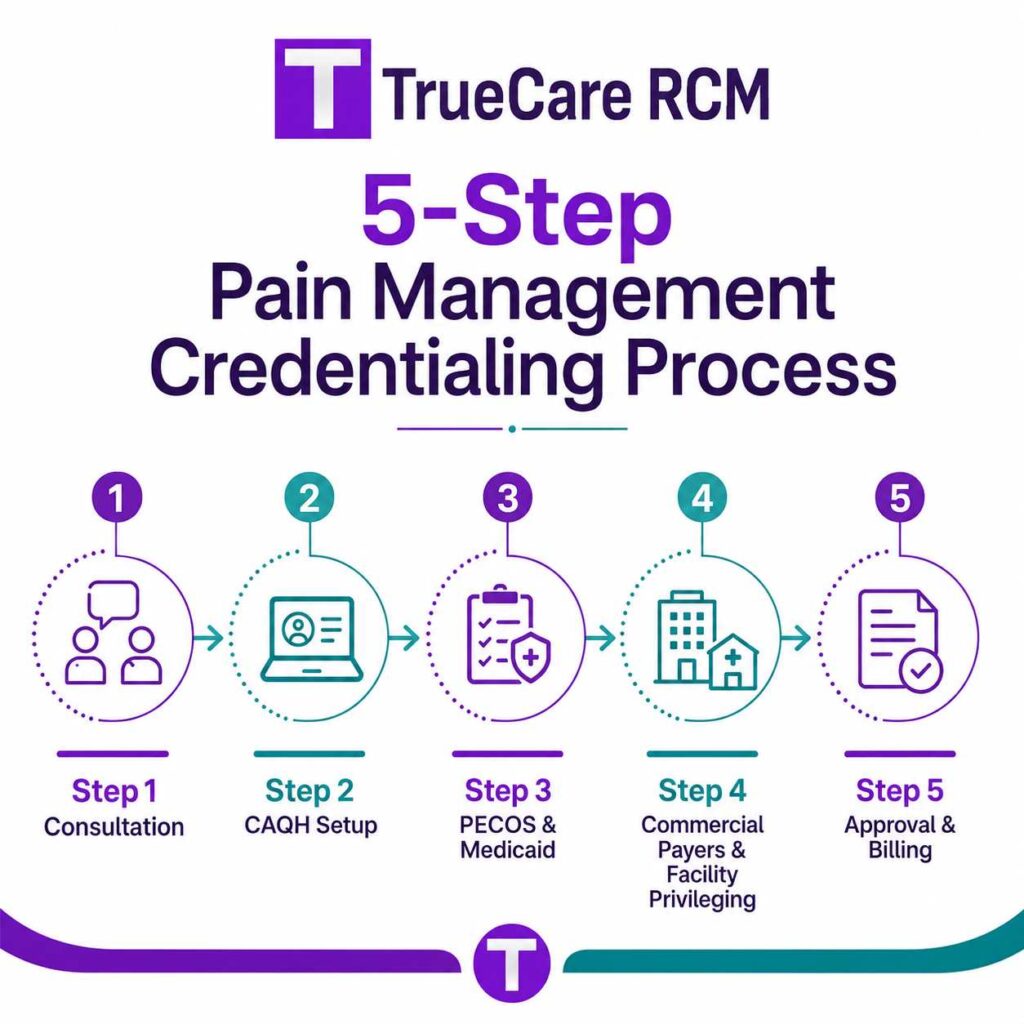
Step – 01
Step – 02
Step – 03
Step – 04
Step – 05
How Long Pain Management Credentialing Takes — Realistic Timelines
Credentialing timelines for pain management depend on payer type and whether facility privileging is involved. Here’s what to realistically plan for:
| Payer / Process | Typical Timeline | Notes |
| Medicare (PECOS) | 60–120 days | High-demand states (CA, NY, TX) typically run longer |
| Medicaid | 60–120 days | State-specific variation — some programs require 90+ days |
| Commercial Payers | 45–90 days | Dependent on CAQH completeness and current payer backlog |
| ASC / Hospital Facility Privileging | 60–120 days | Medical staff committee review runs separately from payer credentialing; required for interventional procedures |
| CAQH Attestation Cycle | 30–45 days | Re-attest every 120 days — lapses stall all active applications |
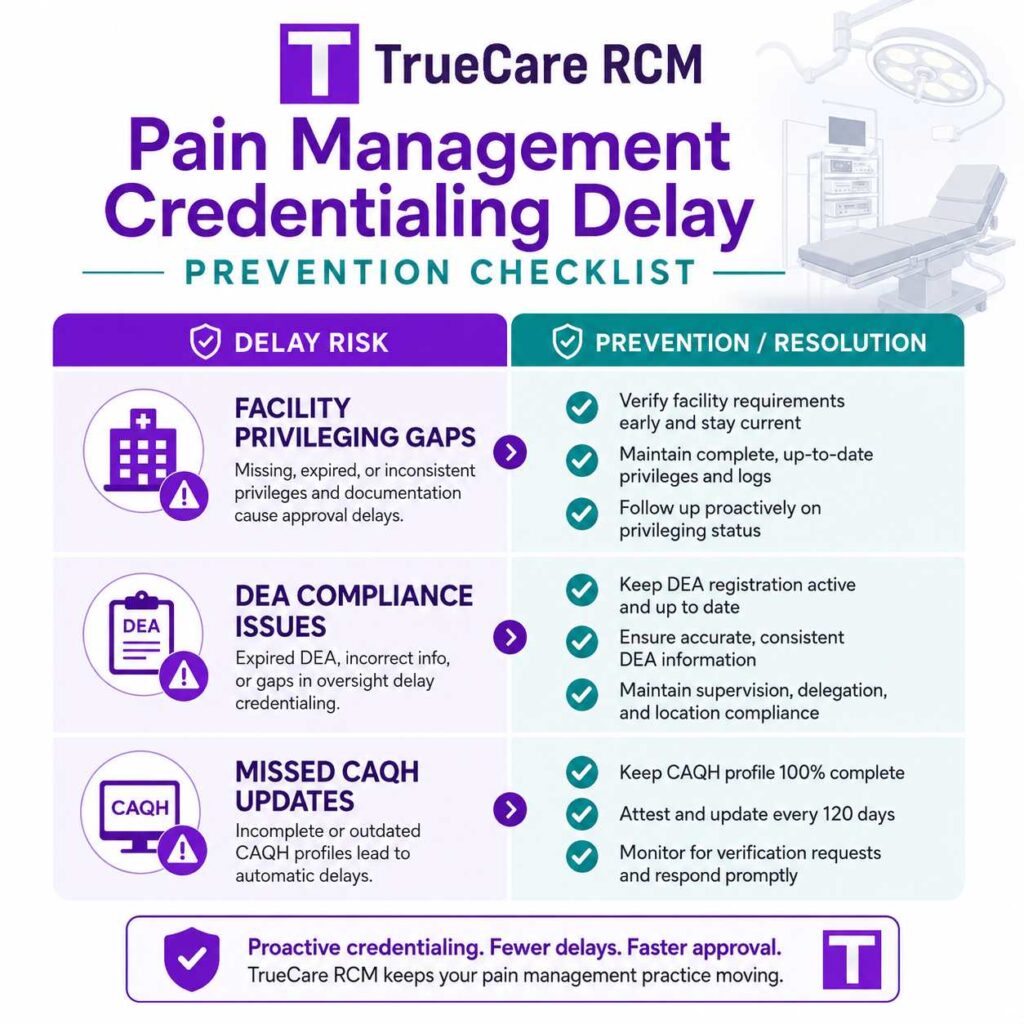
Common Pain Management Credentialing Delays — And How We Prevent Them
Most delays are preventable. Here’s what typically derails pain management credentialing, and exactly what we do about it:
| Common Delay | How TrueCare RCM Prevents It |
| Physician begins scheduling procedures before facility privileging is approved | We track privileging status alongside payer credentialing and flag exactly when a physician is fully cleared to perform procedures |
| DEA or controlled substance license expired or not state-compliant | Expiration dates and state-specific requirements tracked; renewals flagged proactively before any payer or facility notices the gap |
| NP/PA supervision documentation missing for pain management mid-levels | We document and submit the required supervision relationship for every NP/PA application, per payer and state requirements |
| Incorrect taxonomy codes for interventional pain management | Taxonomy codes verified against each payer’s requirements before every filing |
| Expired malpractice certificates | Expiration dates tracked; renewals flagged proactively before any payer notices the gap |
| Missed CAQH re-attestation | Attestation calendar owned and managed — re-attestation completed every 120 days without prompting |
| Stalled applications in high-demand states | Weekly follow-up and escalation to dedicated payer contacts — no application sits idle for more than 7 days |
Who We Serve in Pain Management
Our pain management credentialing services support the full range of interventional and non-interventional pain care models.
| Practice Type | How We Help |
| Solo Interventional Pain Physicians | Complete enrollment from scratch across Medicare, Medicaid, and commercial payers |
| Anesthesiology-Trained Pain Specialists | Credentialing coordinated alongside facility privileging for procedure-based care |
| Physical Medicine & Rehabilitation Pain Providers | Credentialing tailored to PM&R-based pain management practice models |
| Multi-Provider Pain & Spine Groups | Multi-physician credentialing and facility privileging coordinated at scale |
| NP/PA Pain Management Care Teams | Mid-level credentialing filed under the correct supervision structure at every payer |
| Outpatient Procedure Centers | Facility-level credentialing coordinated alongside individual physician enrollment |
Frequently Asked Questions About Pain Management Credentialing Services
Everything pain management practices need to know about credentialing — answered directly.
Pain management credentialing services manage the formal process of verifying a pain physician’s qualifications with insurance payers and facilities so they can bill for services and perform interventional procedures. This includes CAQH profile setup, Medicare PECOS enrollment, Medicaid applications, commercial payer credentialing, and ASC or hospital facility privileging.
Payers require credentialing to verify a provider’s licensure, training, board certification, and malpractice coverage before agreeing to reimburse services. Without approved credentialing, claims submitted to Medicare, Medicaid, or commercial insurers will be denied.
Medicare (PECOS) and Medicaid typically take 60–120 days. Commercial payers average 45–90 days. ASC or hospital facility privileging — required for interventional procedures and separate from payer credentialing — typically runs 60–120 days through the facility’s medical staff committee.
Pain management credentialing requires: MD or DO degree certificate, residency and fellowship completion certificates, board certification, state medical license, DEA registration, malpractice insurance certificate, and a complete CAQH profile.
Yes. CAQH ProView is used by 1,400+ insurers as the foundation for commercial payer credentialing applications. Profiles must be re-attested every 120 days to remain active.
Credentialing is the verification process confirming a provider’s qualifications. Payer enrollment is the broader contracting process that registers the provider in the payer’s claims system so claims can be processed and paid. Facility privileging is a separate, third process specific to performing procedures at a given location.
No. Claims submitted before credentialing approval will be denied. TrueCare RCM confirms exact effective dates for each payer and facility so your billing team knows precisely when it’s safe to submit claims.
Yes. Procedures like epidural steroid injections, nerve blocks, radiofrequency ablation, and spinal cord stimulation typically require facility privileging at the hospital or ambulatory surgery center where they’re performed — a separate process from payer credentialing.
Yes. NPs and PAs working in pain management settings require their own NPI registration, taxonomy codes, and payer enrollment, along with documentation of the supervising or collaborating physician relationship required by many payers.
Yes. If multiple providers bill under a shared Tax ID, the group itself must be enrolled separately, and individual providers must file reassignment of benefits so payments route correctly.
Absolutely. Medicare PECOS enrollment and Medicaid state enrollment are core components of every credentialing engagement we manage for pain management physicians and groups.
At minimum: Medicare, Medicaid, and the major commercial payers active in your market — BCBS, Aetna, UHC, and Cigna. Medicare enrollment is especially significant given the prevalence of chronic pain conditions among Medicare-eligible patients.
Most commercial payers require recredentialing every 2–3 years. Medicare revalidation is typically required every 5 years. CAQH profiles must be re-attested every 120 days. Facility privileging also has its own renewal cycle, separate from payer recredentialing.
Common causes include a physician scheduling procedures before facility privileging is approved, DEA or controlled substance licensure gaps, missing NP/PA supervision documentation, incorrect taxonomy codes, and missed CAQH re-attestation.
Pain management credentialing involves coordinating payer enrollment with facility privileging across potentially multiple procedure sites — a workload that compounds for multi-provider or multi-site groups. Outsourcing to TrueCare RCM means every payer and facility track moves forward simultaneously and is tracked centrally.
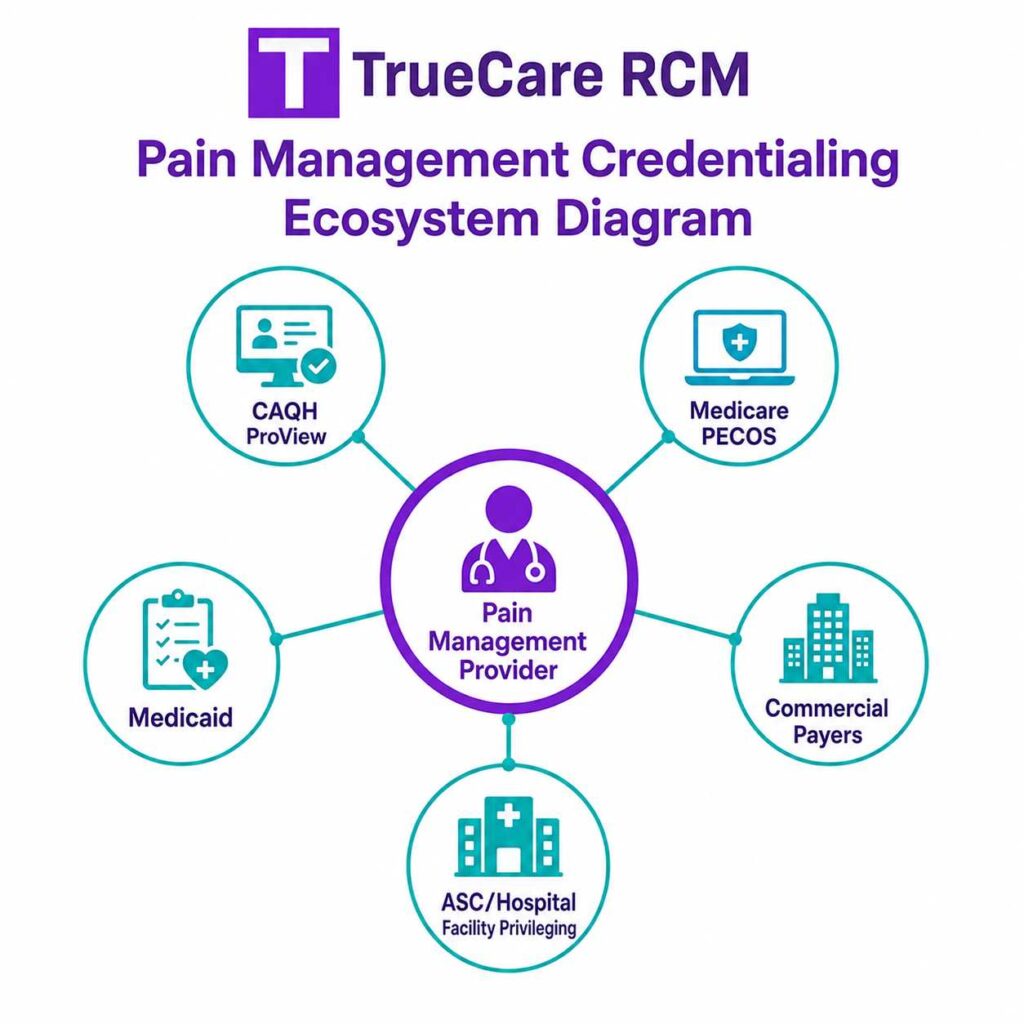
Why Pain Management Credentialing Matters for Practice Revenue
Interventional pain management occupies a unique position in healthcare credentialing: procedure-based care requires facility privileging in addition to standard payer credentialing, controlled substance prescribing adds compliance layers, and care teams frequently mix physicians with NPs and PAs.
Procedures like epidural injections, nerve blocks, and spinal cord stimulation require facility privileging at the ASC or hospital where they’re performed — a process entirely separate from, and often slower than, standard payer credentialing.
Pain management’s reliance on controlled substance prescribing means DEA registration and state-specific controlled substance licensure must be tracked carefully alongside standard credentialing — lapses here can affect both prescribing authority and payer standing.
Many pain management practices rely on nurse practitioners and physician assistants for follow-up care and medication management. Each requires independent credentialing with correct supervision documentation, which varies by payer and state.
Interventional pain management taxonomy must be applied consistently across NPI, PECOS, CAQH, and every payer application — distinct from general anesthesiology or physical medicine and rehabilitation taxonomy codes.
More than 1,400 commercial insurers pull credentials directly from CAQH ProView. A complete, current profile accelerates every commercial application; an incomplete or lapsed one stalls them all simultaneously.
New pain management practices and physicians joining a new procedure site face compounding credentialing exposure — every payer relationship and every facility’s privileging must be built and tracked independently. Starting early at every site minimizes the unbillable window.
Pain Management Credentialing Documentation Checklist
Before a single application leaves our office, every document needs to be in place. Here’s the full checklist we work through for every pain management provider we credential:
Core Credentials
- MD or DO degree certificate
- Residency completion certificate
- Pain management fellowship training documentation
- Board certification (anesthesiology, PM&R, or pain medicine subspecialty)
Licensing & Registrations
- Current state medical license (in every state where you practice)
- DEA registration certificate
- State-specific controlled substance license, where required
- NPI — both individual (Type 1) and group (Type 2) if applicable
Insurance & Compliance
- Malpractice insurance certificate ($1M/$3M minimum coverage typical)
- OIG exclusion check clearance
- NPDB query
Facility Privileging Documentation (If Applicable)
- ASC or hospital medical staff application
- Proof of procedural competency and case logs, if required
- NP/PA supervision or collaboration agreement documentation
Pain Management Credentialing Glossary — Key Terms Explained
| Term | Definition |
| CAQH ProView | Universal credentialing database used by 1,400+ insurers. Requires re-attestation every 120 days. |
| PECOS | CMS Medicare enrollment system. Pain management physicians enroll individually and as part of any group. |
| Facility Privileging | A facility-specific credentialing process, separate from payer credentialing, granting a physician authorization to perform interventional procedures at a particular ASC or hospital. |
| Interventional Pain Management | A pain medicine subspecialty focused on procedure-based treatments such as injections, nerve blocks, and spinal cord stimulation, requiring facility privileging in addition to payer credentialing. |
| NPI Type 1 / Type 2 | Type 1 is the individual provider identifier; Type 2 is the group/organization identifier. Both required for group billing. |
| Taxonomy Code (Pain Management) | NUCC code identifying a provider’s specialty as interventional pain management, distinct from general anesthesiology or PM&R taxonomy. |
| Controlled Substance License | A state-specific registration required for prescribing controlled substances, tracked alongside DEA registration for pain management providers. |
| Reassignment (PECOS) | Process by which an individual provider reassigns Medicare payment rights to a group, filed via CMS-855R. |
| Recredentialing / Revalidation | Re-verification of provider credentials, typically every 2–3 years for commercial payers and every 5 years for Medicare. |
Get Started with Pain Management Credentialing Today
Avoid enrollment delays, protect your revenue, and get your pain management practice billing in-network faster with TrueCare RCM. Our dedicated credentialing team manages every step — from CAQH setup to facility privileging coordination — so your practice can focus on patient care while we handle the paperwork.
Contact us today for a free credentialing consultation.