
Commercial payer credentialing typically requires 60–120 days of planning, although complex applications and contracting can take longer. For practice managers, clinic owners, and solo physicians in Texas, Florida, and California, delays can disrupt scheduling, insurance participation, and revenue.
Quick answer: Allow 60–120 days for commercial credentialing and onboarding, and begin preparations 120–150 days before a physician’s start date when possible. These are planning estimates, not guaranteed payer processing times or verified statewide averages.
This guide compares the three states, explains common bottlenecks, and shows how to prevent avoidable enrollment delays.
Commercial Payer Credentialing Timelines: Texas vs. Florida vs. California
Commercial insurance companies follow their own credentialing and contracting procedures. Processing time depends on the payer, application completeness, provider specialty, and network requirements.
| State | Planning Window | Common Delays |
|---|---|---|
| Texas | 60–120 days | Group affiliation, network participation, and payer onboarding |
| Florida | 60–120+ days | Documentation review, contracting, and network availability |
| California | 60–120+ days | IPA delegation, contracting, and health plan activation |
Note: These are conservative operational planning ranges, not published statewide averages. Individual payers may process complete applications faster or slower.
Credentialing Approval vs. Network Activation
Credentialing approval does not always mean a physician can immediately submit in-network claims. Contracting and system activation may require additional processing.
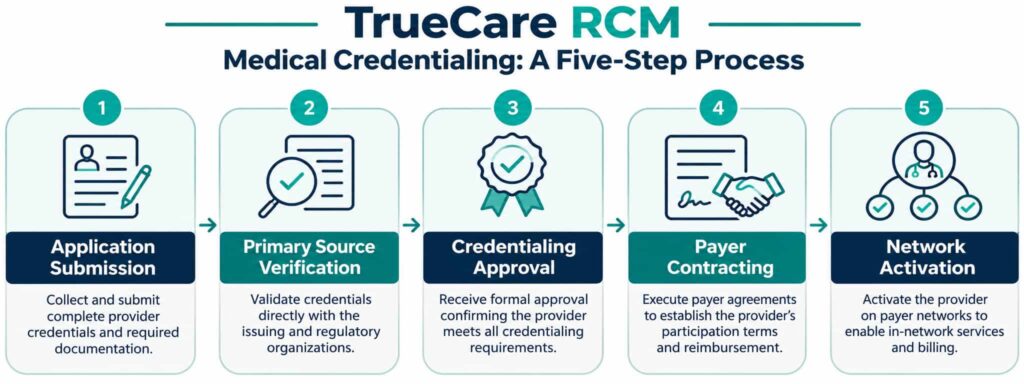
- Application: Submit complete provider and practice information.
- Verification: The payer verifies licenses, training, and qualifications.
- Approval: The credentialing organization issues its decision.
- Contracting: Complete applicable network participation agreements.
- Activation: Confirm the provider’s effective date and billing status.
UnitedHealthcare, for example, describes credentialing and contract loading as separate activities. Practices should confirm both before treating a provider as participating.
How Long Does Commercial Payer Credentialing Take in Texas?
Texas practices should allow approximately 60–120 days for credentialing and related onboarding. Actual processing depends on the insurer and whether the physician joins an existing contracted group.
Major commercial payers include Blue Cross and Blue Shield of Texas (BCBSTX), Aetna, Cigna Healthcare, and UnitedHealthcare.
Texas Credentialing Laws and Expedited Options
Texas Insurance Code Chapter 1452 establishes credentialing requirements and special provisions for eligible physicians joining established medical groups.
Under qualifying circumstances, expedited provisions may affect payment arrangements while credentialing remains pending. They do not guarantee immediate approval or apply automatically to every physician.
BCBSTX also uses CAQH information for many professional credentialing applications. Its published guidance describes an initial completeness review averaging 8–10 calendar days, not the entire credentialing process.
Common Texas Credentialing Delays
- Incorrect NPI, TIN, or medical group information.
- Missing malpractice insurance or license documentation.
- Incomplete CAQH profiles or payer authorization.
- Network restrictions affecting certain specialties or locations.
- Unconfirmed contract and network effective dates.
Action for Texas practice managers: Confirm whether the application qualifies for expedited treatment. Request written confirmation of the physician’s network effective date before billing as participating.
How Long Does Commercial Payer Credentialing Take in Florida?
Florida practices should generally plan for 60–120 days or longer when commercial credentialing includes contracting and network activation.
Common commercial insurers include Florida Blue, Aetna, UnitedHealthcare, Cigna, and Humana. Each may have different documentation and participation requirements.
Why Florida Applications Get Delayed
Incomplete records and unresolved contracting requirements can delay provider onboarding. A completed CAQH profile alone does not establish network participation.
Common problems include:
- Outdated practice addresses or provider information.
- Missing professional liability insurance documentation.
- Incomplete education, training, or employment history.
- Unresolved hospital privilege or coverage requirements.
- Missing contracts or group affiliation details.
Florida Medicaid enrollment and Medicaid managed care participation are separate from commercial payer credentialing. Practices should track these processes independently.
What Florida Practice Managers Should Do
Create a separate tracking record for every insurer. Record the submission date, application reference, missing documents, contracting status, and confirmed effective date.
If a physician starts within 30 days and participation remains unresolved, contact the payer’s provider relations or network management department.
Important: Do not promise in-network benefits until the insurer confirms the physician’s participation for the relevant plan and service location.
How Long Does Commercial Payer Credentialing Take in California?
California practices should allow approximately 60–120 days or longer for credentialing, contracting, and activation. The process may involve health plans, medical groups, and Independent Physician Associations (IPAs).
Relevant insurers include Anthem Blue Cross, Blue Shield of California, Health Net, Aetna, and UnitedHealthcare.
California’s New 90-Day Credentialing Rule
California Assembly Bill 1041 establishes a 90-day credentialing determination requirement for applicable completed applications, including required third-party verifications.
The statewide implementation deadline is January 1, 2027. Some insurers have adopted the standards earlier, including Health Net in October 2026.
Critical distinction: The 90-day requirement concerns credentialing decisions. It does not guarantee that contracting and network activation will finish within the same period.
Practice managers should document when an application becomes complete and confirm which regulatory requirements apply to their insurer.
How IPA Delegation Affects California Providers
Some California health plans delegate credentialing responsibilities to IPAs or medical groups. These arrangements can introduce additional coordination requirements.
Before submitting an application, confirm:
- Which organization performs credentialing.
- Who manages the participation agreement.
- Whether additional group affiliation steps apply.
- Who confirms the final network effective date.
For state-specific assistance, explore our medical credentialing services in California.
How Much Revenue Can Credentialing Delays Put at Risk?
Credentialing delays can affect expected collections when physicians cannot participate in planned insurance networks. The financial impact depends on payer mix, appointment volume, and reimbursement arrangements.
Consider a physician projected to generate $500,000 in annual collections over 260 working days.
Estimated daily collections: $500,000 ÷ 260 = approximately $1,923 per working day.
| Affected Working Days | Illustrative Revenue Exposure |
|---|---|
| 30 days | $57,692 |
| 45 days | $86,538 |
| 65 days | $125,000 |
| 90 days | $173,077 |
A 90-calendar-day delay represents approximately 65 working days in this simplified example, creating about $125,000 in potential collections exposure.
These amounts are illustrative, not confirmed financial losses. Actual losses depend on whether services can be rescheduled, billed appropriately, or reimbursed later.
Credentialing delays can also affect claims processing and reimbursement. Learn how TrueCare RCM supports medical billing services in Texas and medical billing services in Florida
to help practices coordinate enrollment and revenue cycle operations.
Is Delayed Credentialing Affecting Your Practice Revenue?
TrueCare RCM helps medical practices coordinate commercial payer applications, CAQH maintenance, provider enrollment, and follow-up.
5 Ways to Prevent Avoidable Commercial Credentialing Delays
There is no guaranteed shortcut to payer approval. However, organized documentation and timely follow-up can reduce preventable processing problems.
1. Prepare Complete Provider Documentation
Collect the required information before submitting applications:
- Individual and organizational NPI details.
- Active professional licenses and certifications.
- Education, training, and employment history.
- Malpractice insurance and relevant coverage information.
- Practice locations, taxonomy codes, W-9, and TIN.
Check each payer’s specific documentation requirements. Do not assume every insurer requires the same work history period.
2. Keep CAQH Information Current
CAQH generally requires provider re-attestation every 120 days, with a 180-day cycle for Illinois providers.
Update changed information immediately. Verify that the insurer has permission to access the profile.
3. Submit Eligible Applications in Parallel
Where permitted, prepare commercial payer applications concurrently instead of waiting for unrelated enrollment processes to finish.
Medicare, Medicaid, and commercial enrollment have separate requirements. Confirm whether a specific payer requires another enrollment or identifier first.
4. Track Applications and Follow Up
Maintain a credentialing tracker with application numbers, submission dates, outstanding items, payer contacts, and next actions.
Consider follow-ups every 10–14 business days unless the payer provides another schedule. Request written confirmation when an application becomes complete.
5. Verify Effective Dates Before Billing
Confirm credentialing approval, contract status, group affiliation, service location, and network activation.
Coordinate these details with your billing team before submitting claims as an in-network provider.
What Should You Do When Credentialing Is Already Delayed?
If an application remains pending after 60 or 90 days, identify the exact bottleneck before resubmitting documents.
- Confirm receipt: Ask whether the payer received the complete application.
- Identify missing items: Request a specific list of outstanding documents.
- Check the processing stage: Determine whether credentialing, contracting, or activation is pending.
- Escalate appropriately: Contact provider relations or the responsible delegated organization.
- Protect billing: Review affected appointments, claim filing limits, and participation rules.
Do not assume commercial claims can be backdated. Retroactive effective dates depend on payer contracts and applicable rules.
When Should a Medical Practice Outsource Credentialing?
Outsourcing may help when internal staff cannot consistently manage applications, documentation, and payer follow-up.
Common situations include opening a new clinic, hiring several physicians, expanding into another state, or resolving multiple delayed applications.
A credentialing partner can organize submissions, monitor outstanding requirements, and coordinate communication with insurers.
TrueCare RCM provides provider enrollment and credentialing services for medical practices seeking structured enrollment support.
Frequently Asked Questions About Commercial Payer Credentialing
How long does commercial insurance credentialing take?
Allow approximately 60–120 days for planning. Actual processing depends on the payer, application completeness, contracting requirements, and provider network availability.
Is Texas credentialing faster than Florida or California?
Not necessarily. Texas offers specific expedited provisions for eligible physicians, but no reliable universal ranking applies across all commercial insurers.
Can physicians see patients while credentialing is pending?
Properly licensed physicians may provide services when otherwise permitted. However, pending credentialing does not guarantee in-network reimbursement. Practices must follow applicable payer contracts and billing rules.
Does CAQH approval mean insurance credentialing is complete?
No. CAQH stores provider information for authorized organizations. Each payer still completes its applicable credentialing and participation procedures.
Can commercial insurance credentialing be backdated?
Sometimes, depending on the payer’s contract and effective-date policies. Medicare retrospective billing rules are separate and do not automatically apply to commercial insurance.
How early should a clinic begin credentialing a new physician?
Begin approximately 120–150 days before the planned start date when possible. Complex applications, new group contracts, or delegated credentialing may require more time.
What causes insurance credentialing applications to be delayed?
Common causes include incomplete CAQH profiles, missing licenses, inconsistent provider records, outstanding verifications, network restrictions, and unresolved contracts.
Get Commercial Payer Credentialing Assistance From TrueCare RCM
Credentialing delays can disrupt patient access, practice operations, and expected collections. A structured enrollment process helps your team identify issues before they affect billing.
TrueCare RCM supports commercial payer credentialing, CAQH maintenance, provider enrollment, and application follow-up for physicians and medical groups.
Have an application pending in Texas, Florida, or California? Contact our team to discuss the current status, outstanding requirements, and next steps.
Sources and Regulatory References
- Texas Insurance Code, Chapter 1452
- Texas Department of Insurance — Credentialing Application
- UnitedHealthcare — Join Our Network
- Health Net California — Credentialing Application Process
- CAQH — Provider Data Portal
- 42 CFR § 424.521 — Medicare Retrospective Billing
- California Health and Safety Code § 1374.198 — AB 1041
- BCBSTX — Professional Provider Credentialing Process
- Wellpoint Florida — Commercial Network Credentialing
Editorial note: Processing windows are planning estimates, not guaranteed approval timelines. Requirements vary by insurer, provider type, network, and contract. This article provides general operational information, not legal or reimbursement advice.