
At TrueCare RCM, we provide specialized podiatry credentialing services that get your podiatrists enrolled with Medicare, Medicaid, and commercial payers — quickly, correctly, and without revenue gaps. Whether you are a new graduate, expanding to a second location, or managing recredentialing across a multi-provider group, our enrollment experts handle every step so you can focus on patient care.
Complete Provider Enrollment & Credentialing Support for Podiatry Practices
Podiatry Credentialing Services for Foot & Ankle Practices
Medicare Part B and PECOS enrollment for individual podiatrists and group practices
✅ State Medicaid enrollment and revalidation for all 50 states
✅ Commercial payer credentialing — BCBS, Aetna, UHC, Cigna, and all regional plans
✅ CAQH ProView setup, maintenance, and re-attestation management
✅ Group NPI (Type 2) registration, taxonomy codes, and reassignment of benefits
✅ Proactive follow-up and escalation — we drive your application to approval
Complete Provider Enrollment and Credentialing Support for Podiatry Practices
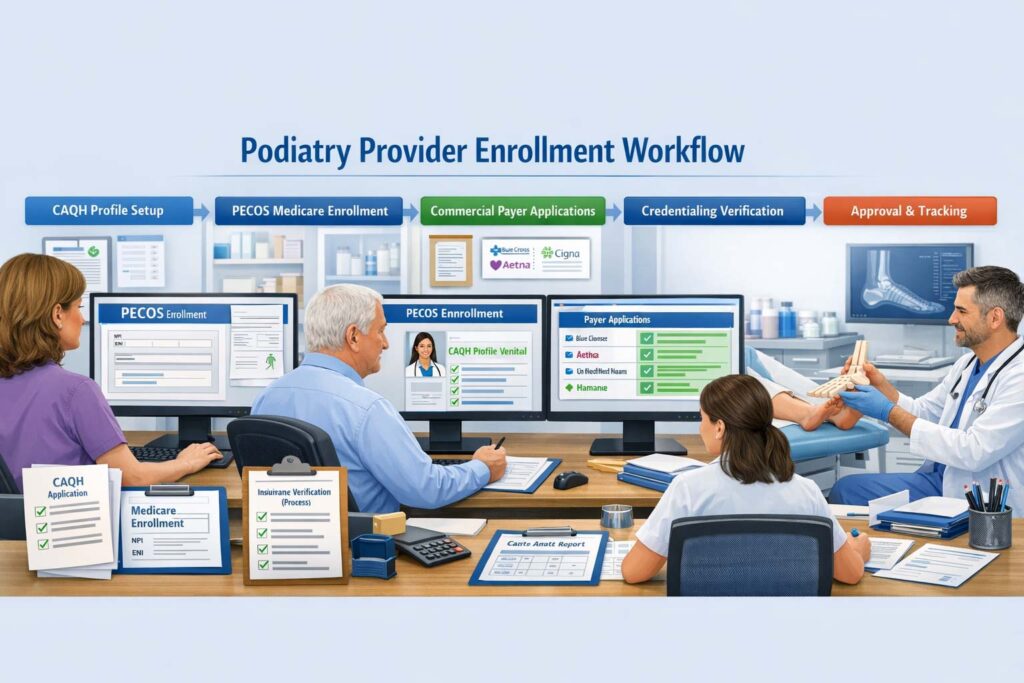
Podiatry credentialing delays cost practices real money. Every week a podiatrist is not credentialed is a week of appointments that cannot be billed in-network. At TrueCare RCM, we specialize in getting podiatrists enrolled quickly, correctly, and tracked through to full approval — with zero gaps in your revenue.
From CAQH ProView setup and NPI verification to PECOS enrollment, state Medicaid applications, and commercial payer contracting — our dedicated credentialing coordinators manage the entire process with proactive follow-up and real-time status updates at every stage.
Our credentialing team works closely with our podiatry billing services team to ensure claims are ready to submit on your effective date.
90-120
Day Avg. Enrollment
1,400+
Payers Use CAQH
100%
Dedicated Coordinator
0
Revenue Gaps Tolerated
24/7
Billing & Coding Support

Why Podiatry Credentialing Is Different from General Medical Credentialing
Podiatry credentialing involves unique considerations that most general billing companies are not equipped to handle. The combination of state-specific podiatry licensing boards, ABPM and ABFAS board certification requirements, DME supplier enrollment, and payer-specific restrictions for DPMs creates a uniquely complex enrollment landscape.
State Podiatry Licensing Boards
Unlike general medicine, podiatrists are licensed through state-specific podiatry boards — not general medical boards. Each state has its own licensing requirements, renewal cycles, and primary source verification procedures. Credentialing applications must reference the correct issuing board for each state, and cross-state credentialing requires separate license applications in each jurisdiction.
ABPM and ABFAS Board Certification
Most commercial payers require podiatrists to hold board certification from either the American Board of Podiatric Medicine (ABPM) or the American Board of Foot and Ankle Surgery (ABFAS) to participate in their networks. Board-eligible providers may be credentialed conditionally, but ongoing certification requirements — including continuing certification and self-assessment examinations — must be maintained to preserve network participation status.
PECOS and Medicare Part B Enrollment
Podiatrists are Medicare Part B providers and must enroll through PECOS using Form CMS-855I for individuals and CMS-855B for group enrollment. Reassignment of benefits via CMS-855R links individual podiatrists to their group NPI. Using the correct taxonomy code — 213E00000X for general podiatric medicine — across every application is critical to preventing directory errors and claim denials from day one.
CAQH ProView and 120-Day Attestation
Over 1,400 insurers use CAQH ProView as their centralized credentialing database. A complete, attested CAQH profile is a prerequisite for most commercial payer applications. CAQH requires re-attestation every 120 days — missing this window causes your profile to go inactive, stalling all in-progress applications immediately. For new podiatrists, setting up CAQH correctly from the start — DEA, malpractice history, hospital privileges, education — is essential to avoiding downstream delays.
DME Supplier Enrollment
Podiatrists who dispense custom orthotics, diabetic shoes, or other DME may need additional enrollment as a DME supplier through PECOS — separate from standard Part B provider enrollment. Billing HCPCS codes without DME supplier enrollment is a compliance risk. Our team identifies whether DME supplier enrollment applies to your practice and manages that process in parallel.
Hospital and ASC Privileging
Podiatrists who perform surgeries at hospitals or ambulatory surgical centers (ASCs) must undergo a separate credentialing process with each facility’s medical staff office. This is entirely distinct from payer credentialing and involves different documentation requirements, peer references, and privileging committees. TrueCare RCM manages both payer and facility credentialing simultaneously to avoid timeline conflicts.
Our Podiatry Credentialing Services
Our credentialing services are built specifically for foot and ankle practices — covering every enrollment workflow from initial setup through ongoing recredentialing, with a dedicated coordinator at every stage.
✔ CAQH ProView Setup and Maintenance
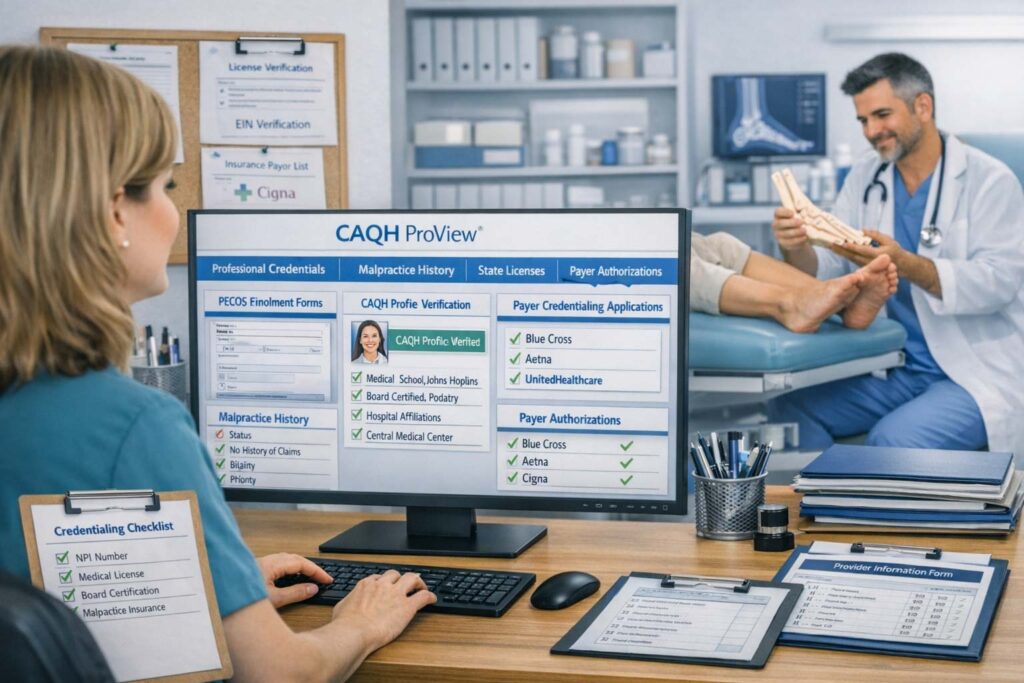
We build your CAQH ProView profile from scratch with all required sections complete — education, residency, DEA, malpractice history, hospital affiliations, and insurance information. We manage re-attestation every 120 days so your profile never goes inactive during active applications.
✔ Medicare Part B and PECOS Enrollment
Complete CMS-855I (individual) and CMS-855B (group) enrollment via PECOS. We verify the correct podiatry taxonomy code (213E00000X), coordinate reassignment of benefits (CMS-855R), manage MAC-specific requirements, and track your application through to your Medicare Effective Date.
✔ State Medicaid Provider Enrollment
We manage Medicaid enrollment in all 50 states — navigating each unique portal, documentation requirement, and processing timeline. For multi-state practices, applications run in parallel. We handle fee schedule reviews, Medicare-first sequencing where required, and revalidation deadlines.
✔ Commercial Payer Credentialing and Contracting
Full credentialing applications submitted to BCBS, Aetna, UHC, Cigna, Humana, and all regional plans. We identify open panels, manage closed-panel escalations, track contracting separately from credentialing, and obtain your effective participation date with each payer.
✔ NPI Registration and Taxonomy Code Verification
We verify your NPI Type 1 (individual) and register or update your NPI Type 2 (group) with the correct podiatry taxonomy code (213E00000X). We correct taxonomy mismatches across PECOS, CAQH, and payer applications — a common source of claim denials that starts at credentialing.
✔ Group Practice Enrollment and Reassignment of Benefits
We handle Type 2 NPI group enrollment and link all individual podiatrists to the group NPI via CMS-855R reassignment of benefits. Critical for any practice billing under a group TIN. We verify the link is active in PECOS and confirmed by the MAC before any claims go out.
✔ EFT and ERA Enrollment
We complete Electronic Funds Transfer (EFT) and Electronic Remittance Advice (ERA) enrollment with Medicare and commercial payers — eliminating paper checks, enabling faster payment posting, and ensuring your billing team is fully set up to receive and reconcile payments from day one of your effective date.
✔ Recredentialing and Revalidation Management
Commercial payers recredential every 2-3 years. Medicare revalidation cycles every 5 years. Missing a deadline triggers network termination. We track every expiration, initiate recredentialing 90 days in advance, and keep your podiatrists continuously enrolled with every payer — no gaps, no surprises.
✔ Hospital and Ambulatory Surgical Center Privileging
For podiatrists performing procedures at hospitals or ASCs, we manage the medical staff credentialing and privileging application process separately from payer enrollment — coordinating peer references, documentation packages, and privileging committee submissions alongside your payer applications.
Get Your Podiatrists Credentialed Faster
Schedule a free credentialing assessment and find out which payers your practice should be enrolled with — and how long it will realistically take.
Common Podiatry Credentialing Challenges — And How We Solve Them
These are the most common obstacles that delay podiatry practices from getting credentialed and paid — and exactly how TrueCare RCM prevents each one.
| CREDENTIALING CHALLENGE | HOW TRUECARE RCM SOLVES IT |
| Wrong Taxonomy Code — Podiatrist enrolled with general physician taxonomy instead of 213E00000X, causing payer directory errors and claim denials from day one | We verify and apply taxonomy code 213E00000X across PECOS, CAQH, and every payer application before submission. We also correct existing taxonomy mismatches. |
| CAQH Profile Expired — Re-attestation missed during an active credentialing application, causing the payer to flag the profile as inactive and stall the application | We monitor re-attestation cycles for every provider and complete CAQH attestation proactively before the 120-day deadline — keeping all active applications moving. |
| Missing ABPM or ABFAS Board Certification Documentation — Payer application rejected because board certification was not submitted or is listed as board-eligible without conditional approval | We verify board certification status (ABPM or ABFAS) at intake and prepare conditional credentialing documentation for board-eligible providers where payers allow it. |
| PECOS Application Rejected — Incomplete supporting documents, missing signatures, or NPI mismatch causing Medicare enrollment to be rejected by the MAC | We prepare and audit every PECOS document before submission. If a rejection occurs, we respond within 24 hours with corrected documentation and resubmit immediately. |
| Reassignment of Benefits Missing — Individual podiatrist not linked to group NPI, causing claims billed under the group TIN to deny as unverified provider | We complete CMS-855R reassignment of benefits as part of every group enrollment and verify the link is active in PECOS before any claims are submitted. |
| Closed Payer Panel — Application submitted to a commercial payer only to find the podiatry panel is closed in that region, wasting weeks of processing time | We research panel status before submitting applications. For closed panels, we initiate escalation requests with clinical need documentation to support panel opening exceptions. |
| Revalidation Deadline Missed — Medicare or payer enrollment lapsed because the revalidation window was not tracked, triggering network termination and billing interruption | We maintain a credentialing expiration calendar for every provider and every payer. Revalidation is initiated 90-120 days before the deadline — never reactively. |
| Forgotten CAQH Profile After Approval — Provider becomes credentialed but stops maintaining their CAQH profile, causing recredentialing failures 2-3 years later | We provide ongoing CAQH maintenance as part of our credentialing service — re-attestation, profile updates, and document refreshes throughout the relationship. |
Realistic Podiatry Credentialing Timelines and Our Process
The standard credentialing process can take 90-120 days or longer — which is why it is essential to start well before your intended start date. Here is a realistic breakdown by payer type and what you can do to protect revenue during the waiting period.
Credentialing Timeline by Payer Type
| Payer Type | Standard Timeline | Fastest Possible | Common Delay Causes |
| Medicare Part B (PECOS) | 60-120 days | 45 days | Missing documents, wrong taxonomy code, MAC backlog |
| State Medicaid | 90-180 days | 30 days (varies by state) | State portal delays, Medicare-first sequencing |
| BCBS, Aetna, UHC, Cigna | 45-90 days | 30 days | Inactive CAQH, closed panel, contracting delays |
| CAQH ProView Setup | 7-14 days | 3-5 days with specialist | Incomplete education section, missing malpractice dates |
| Medicare Revalidation | 30-60 days | 21 days | Late submission, outdated licensure or insurance docs |
| Hospital / ASC Privileging | 60-90 days | 45 days | Pending peer references, committee meeting schedules |
| Commercial Recredentialing | 30-60 days | 21 days | Unresponded info requests, outdated liability coverage |
Struggling With Routine Foot Care Denials?
Our certified podiatry coders ensure correct Q modifiers, LCD compliance, and clean claims every time — so your routine foot care services actually get paid.
Why Podiatry Practices Choose TrueCare RCM for Credentialing
TrueCare RCM combines podiatry-specific enrollment expertise with a proactive, coordinator-driven process that moves your applications forward — not just tracks them. We know the difference between a stalled application and a closed panel. We know when to escalate and exactly who to call.
Our credentialing support integrates with our billing team — so when your credentialing is complete, your billing workflow is already in place and claims go out on day one of your effective date.
| What You Get | What That Means for Your Practice |
| Dedicated Credentialing Coordinator | One specialist manages all your applications — you always have a direct contact, not a call center queue |
| Correct Taxonomy From Day One | 213E00000X verified across every application — preventing the most common podiatry credentialing error before it happens |
| ABPM and ABFAS Expertise | We know the board certification requirements for every major payer — and how to credential board-eligible providers conditionally where allowed |
| Proactive Follow-Up Schedule | We contact payers on a defined timeline — applications never sit idle waiting for someone to check on them |
| Billing Integration on Approval | Your billing team is ready when credentialing is complete — claims go out immediately at your effective date |
| NPDB and OIG Checks Included | We run NPDB and OIG exclusion checks as part of every enrollment — catching compliance issues before they block credentialing |
What Our Clients Achieve
| Zero Revenue Gaps — Pending Approval Letters protect retroactive billing rights
Faster Effective Dates — Proactive follow-up shortens timelines by 2-4 weeks No Missed Deadlines — Revalidation tracked 90 days in advance for every payer |
Complete Documentation — Every enrollment package is audit-ready from day one
Multi-Payer Coordination — All payers managed simultaneously, not sequentially Billing-Ready Handoff — Claims go out on your effective date, not weeks later |
Frequently Asked Questions About Podiatry Credentialing
Podiatry credentialing services handle the process of enrolling podiatrists with insurance payers — including Medicare, Medicaid, BCBS, and commercial plans — so the practice can be reimbursed for covered foot and ankle services. Unlike general provider enrollment, podiatry credentialing requires expertise in state podiatry licensing boards, ABPM and ABFAS board certification, DME supplier enrollment, and specialty-specific payer requirements.
Podiatry credentialing involves state-specific podiatry licensing boards (not general medical boards), board certification requirements through ABPM or ABFAS, and particular documentation requirements for foot and ankle specialists. Podiatrists may also require separate DME supplier enrollment, hospital and ASC privileging, and specific taxonomy codes that differ from general physician enrollment.
The standard credentialing process takes 90-120 days or longer, depending on the payer and state. Medicare Part B typically takes 60-120 days; commercial payers take 45-90 days; state Medicaid ranges from 60-180 days. It is essential to start the process well before your intended start date. TrueCare RCM reduces these timelines through proactive follow-up and complete documentation from submission.
CAQH ProView is a centralized database used by over 1,400 insurers to store provider credentialing information. Podiatrists must maintain a complete, up-to-date CAQH profile and re-attest to it every 120 days to allow payers to access their credentials. A lapsed CAQH profile immediately halts in-progress credentialing applications across all payers using that profile.
PECOS (Provider Enrollment, Chain and Ownership System) is the CMS Medicare enrollment system. Podiatrists who wish to treat Medicare patients must enroll through PECOS using CMS-855I (individual) or CMS-855B (group practice). The correct taxonomy code — 213E00000X — must be applied consistently. The MAC reviews and approves applications, and the process typically takes 60-120 days.
Yes. Podiatrists must enroll separately with each insurance plan they wish to participate in — including Medicare, Medicaid, and every commercial payer such as BCBS, UnitedHealthcare, and Cigna. Each payer has its own application portal, documentation requirements, and processing timeline. TrueCare RCM manages all payer applications simultaneously to minimize overall credentialing time.
Required documents typically include: state podiatry license, board certification (ABPM or ABFAS), DEA certificate, NPI number (Type 1 and Type 2), malpractice insurance certificate, curriculum vitae, proof of graduation from a CPME-accredited podiatric medical school, residency completion certificate, work history, and peer references. TrueCare RCM conducts a full document audit at onboarding.
Most insurance companies require recredentialing every 2-3 years. Medicare revalidation occurs every 5 years. CAQH profile re-attestation is required every 120 days. Board certification through ABPM and ABFAS also requires ongoing continuing certification. TrueCare RCM tracks every expiration deadline and initiates recredentialing 90 days in advance.
If you fail to re-attest to your CAQH profile every 120 days, payers can no longer access your credentials. This pauses all active credentialing applications using that profile and can delay enrollment by weeks. TrueCare RCM manages CAQH re-attestation proactively for every provider in our credentialing program.
Yes, but with limitations. You can see patients on a cash-pay or self-pay basis and provide superbills so patients can submit claims for potential out-of-network reimbursement. You cannot bill payers as an in-network provider until credentialing is complete. TrueCare RCM helps obtain Pending Approval Letters from Medicare to protect your right to bill retroactively to your application submission date.
Credentialing verifies a podiatrist’s qualifications to join a payer network. Contracting involves negotiating and finalizing the reimbursement rates, payment schedules, and terms of participation with the payer. Both must be completed before a podiatrist can bill in-network. TrueCare RCM manages both credentialing and contracting as part of our commercial payer enrollment service.
Most commercial payers require podiatrists to be board certified by ABPM (American Board of Podiatric Medicine) or ABFAS (American Board of Foot and Ankle Surgery) to participate in their networks. Board-eligible providers may be credentialed conditionally by some payers while completing the certification process. Ongoing continuing certification requirements must be maintained to preserve network participation.
Failure to maintain current credentials can result in claim denials, payment delays, termination from payer networks, and potential legal issues. Missing a Medicare revalidation deadline causes automatic deactivation of the enrollment. TrueCare RCM prevents these consequences through proactive deadline tracking and recredentialing management.
Yes. If a podiatrist performs surgeries or sees patients at a hospital or ambulatory surgical center, they must undergo a separate credentialing process with that facility’s medical staff office. This is entirely independent of payer credentialing and requires peer references, specific documentation, and approval by a privileging committee. TrueCare RCM manages both payer and facility credentialing simultaneously.
Self-managed credentialing is time-consuming, prone to errors, and often delayed by inactive CAQH profiles, missing board certification documentation, wrong taxonomy codes, or unresponsive payer contacts. TrueCare RCM credentialing specialists know the exact requirements for DPM enrollment, have direct contacts at MACs and payer provider relations teams, and manage every application from submission to approval — so your practice gets paid faster.
Talk to a Podiatry Credentialing Expert
We are available 24/7 to answer your credentialing questions and guide your practice through the enrollment process. Schedule a consultation with a TrueCare RCM specialist and get your podiatrists credentialed faster.
Podiatry Credentialing Glossary
| Term | Definition |
| PECOS | Provider Enrollment, Chain, and Ownership System — the CMS online portal for Medicare provider enrollment. Podiatrists use PECOS to complete CMS-855I (individual) and CMS-855B (group) enrollment applications. |
| CAQH ProView | Centralized credentialing database used by over 1,400 insurers. Providers complete one profile and authorize payers to access it. Requires re-attestation every 120 days to remain active. |
| Taxonomy Code 213E00000X | Standard NUCC taxonomy code for general podiatric medicine (DPM). Must be applied consistently across NPI, PECOS, CAQH, and all payer applications to prevent directory errors and claim denials. |
| NPI Type 1 | National Provider Identifier for individual healthcare providers. Used on all Medicare, Medicaid, and commercial payer claims and applications. |
| NPI Type 2 | National Provider Identifier for organizations and group practices. Must be linked to individual provider NPIs via reassignment of benefits (CMS-855R). |
| ABPM | American Board of Podiatric Medicine — one of the two primary board certification bodies for podiatrists. Most commercial payers require ABPM or ABFAS certification for network participation. |
| ABFAS | American Board of Foot and Ankle Surgery — the second primary board certification body for podiatrists, focusing on surgical subspecialty certification. Required by most payers alongside or in lieu of ABPM. |
| Reassignment of Benefits | Process by which a podiatrist authorizes a payer to send payments to their employer or group practice. Completed via CMS-855R in PECOS. Required for all providers billing under a group NPI. |
| MAC (Medicare Administrative Contractor) | Private company contracted by CMS to process Medicare claims and enrollment applications in a specific geographic region. Reviews, approves, or rejects PECOS applications. |
| NPDB | National Practitioner Data Bank — federal database of malpractice payments and adverse licensing actions. Queried by hospitals and many payers during credentialing. |
| OIG Exclusion List | Office of Inspector General list of providers barred from Medicare and Medicaid participation. Payers screen all credentialing applicants against this list. |
| EFT | Electronic Funds Transfer — electronic bank payment of Medicare reimbursements. Enrolled via CMS-588 in PECOS. Eliminates paper checks and enables faster payment posting. |
| Credentialing vs. Contracting | Credentialing verifies provider qualifications to join a network. Contracting sets reimbursement rates and participation terms. Both are required before in-network billing can begin. |