
Most family practices today include NPs and PAs as core members of the care team. NPs and PAs require their own NPI registration, their own taxonomy codes — typically 363LF0000X for Family Nurse Practitioners and 363A00000X for Physician Assistants — and their own payer enrollment. Many commercial payers also require documentation of the supervising or collaborating physician relationship as part of NP/PA credentialing. Missing this linkage is one of the most common reasons NP and PA claims deny even when the physician is fully credentialed.
Complete Payer Enrollment & Credentialing Support for Family Medicine Practices
Family Practice Credentialing Services for Primary Care Providers
At TrueCare RCM, we provide specialized family practice credentialing services that get your physicians, nurse practitioners, and physician assistants enrolled with Medicare, Medicaid, and commercial payers — quickly, correctly, and without revenue gaps. Whether you are opening a new family medicine clinic, adding a provider, or managing recredentialing across a multi-provider group, our enrollment specialists handle every step so your team can focus on patient care.
✅ Medicare Part B and PECOS enrollment for family physicians, NPs, and PAs
✅ State Medicaid enrollment and revalidation for all 50 states
✅ Commercial payer credentialing — BCBS, Aetna, UHC, Cigna, and all regional plans
✅ CAQH ProView setup, maintenance, and re-attestation management
✅ Credentialing for nurse practitioners and physician assistants under correct taxonomy codes and supervising physician linkage
✅ Proactive follow-up and escalation — we drive every application to approval
Complete Payer Enrollment and Credentialing Support for Family Practices
Family practice credentialing may seem straightforward, but primary care practices often deal with more payer relationships than many specialties. A family medicine clinic may participate with Medicare, Medicaid, commercial payers, managed care plans, local networks, employer-sponsored plans, and regional insurance panels.
That broad payer mix makes accuracy essential. One missed document, outdated CAQH attestation, incorrect taxonomy code, NPI mismatch, unsigned payer agreement, or missing Medicare reassignment can delay approval and create billing problems later.
TrueCare RCM helps family practice clinics avoid these issues by managing credentialing from document collection to billing activation. Our credentialing coordinators track applications, follow up with payers, respond to missing-information requests, and confirm effective dates before your billing team begins submitting claims.
Whether you are credentialing a new family physician, adding an NP or PA, expanding into another office, updating ownership details, or cleaning up delayed payer enrollments, our process is built to reduce confusion and keep your revenue cycle moving.
60–120 Days
Medicare & Medicaid Enrollment
45–120 Days
Commercial Payer Credentialing
100%
Dedicated Credentialing Support
0 Revenue Gaps
With Effective Date Tracking
All Priority States
Nationwide Credentialing Support

Why Family Practice Credentialing Matters for Primary Care Revenue
Family practices face a unique credentialing challenge that most other specialties do not: high payer volume combined with multiple provider types. A typical family medicine clinic sees patients across nearly every insurance plan in its market — Medicare, Medicaid, and a dozen or more commercial payers — and increasingly relies on nurse practitioners and physician assistants to deliver care alongside physicians. Each of these factors adds credentialing complexity.
Because family medicine is a patient’s first point of contact for nearly any condition, family practices typically need to be credentialed with every major payer in their service area — not just one or two specialty-relevant plans. A delay or gap in even one payer credential can mean turning away a meaningful share of new patients or seeing existing patients out-of-network.
Most family practices today include NPs and PAs as core members of the care team. NPs and PAs require their own NPI registration, their own taxonomy codes — typically 363LF0000X for Family Nurse Practitioners and 363A00000X for Physician Assistants — and their own payer enrollment. Many commercial payers also require documentation of the supervising or collaborating physician relationship as part of NP/PA credentialing. Missing this linkage is one of the most common reasons NP and PA claims deny even when the physician is fully credentialed.
The standard taxonomy code for family medicine is 207Q00000X. This must be applied consistently across NPI registration, PECOS, CAQH, and every commercial payer application. Confusing this with adjacent codes — such as internal medicine (207R00000X) or general practice — causes payer directory mismatches, incorrect specialty categorization, and downstream claim denials.
Nearly every commercial payer credentialing application for family practice begins with a complete, attested CAQH ProView profile. With over 1,400 payers relying on CAQH, an incomplete or lapsed profile blocks every commercial application simultaneously — not just one. CAQH requires re-attestation every 120 days, and missed attestations are one of the leading causes of stalled family practice credentialing.
Multi-provider family practice groups affiliated with health systems or large payer networks may be eligible for delegated credentialing — where the payer delegates primary source verification responsibilities to the practice or its credentialing partner, significantly shortening enrollment timelines for new providers. Delegated credentialing agreements require ongoing compliance audits and accurate provider data management.
New family practice clinics and newly hired providers face the longest exposure to credentialing delays, since every payer relationship must be built from zero. Without a structured onboarding process that starts credentialing applications the moment a hire is confirmed — often 60-90 days before their start date — new providers frequently see their first weeks of patients on an out-of-network or self-pay basis.
Credentialing Solutions Tailored for Family Practice and Primary Care Clinics
Our credentialing services are built for the realities of family medicine — multiple provider types, high payer volume, and frequent staffing changes. We manage every enrollment workflow from initial setup through ongoing recredentialing, with a dedicated coordinator at every stage.
CAQH ProView Setup and Maintenance
We build a complete CAQH ProView profile for every provider — physicians, NPs, and PAs alike — covering education, residency or training, malpractice history, hospital affiliations, and insurance information. We manage re-attestation every 120 days so profiles never go inactive during active applications.
Medicare Part B and PECOS Enrollment
Complete CMS-855I (individual) and CMS-855B (group) enrollment via PECOS for physicians, NPs, and PAs. We verify the correct taxonomy code for each provider type, coordinate reassignment of benefits (CMS-855R), and track every application through to its Medicare Effective Date.
State Medicaid Provider Enrollment
We manage Medicaid enrollment in all 50 states for every provider on your team — navigating each state’s portal, documentation requirements, and processing timeline. For multi-state practices, applications run in parallel. We handle Medicare-first sequencing where required and track revalidation deadlines.
Commercial Payer Credentialing and Contracting
Full credentialing applications submitted to BCBS, Aetna, UHC, Cigna, Humana, and every regional payer relevant to your market. Because family practices typically need broad payer participation, we prioritize your highest-volume payers first and track contracting separately from credentialing for each one.
NPI Registration and Taxonomy Code Verification
We verify NPI Type 1 for every individual provider and register or update your NPI Type 2 (group). We apply taxonomy code 207Q00000X for family medicine physicians, and the correct NP and PA taxonomy codes, across PECOS, CAQH, and every payer application — preventing the directory and denial issues that come from taxonomy mismatches.
Credentialing for Nurse Practitioners and Physician Assistants
We manage full credentialing for nurse practitioners and physician assistants — including NPI registration, CAQH profiles, and payer enrollment under the correct taxonomy codes. We document and maintain the supervising or collaborating physician relationship required by many payers, so NP and PA claims process correctly from day one.
Group Enrollment and Reassignment of Benefits
We handle Type 2 NPI group enrollment and link every individual provider — physicians, NPs, and PAs — to the group NPI via CMS-855R reassignment of benefits. We verify each link is active in PECOS and confirmed by the MAC before any claims are submitted under the group.
EFT and ERA Enrollment
We complete Electronic Funds Transfer (EFT) and Electronic Remittance Advice (ERA) enrollment with Medicare and commercial payers for your practice — eliminating paper checks, enabling faster payment posting, and ensuring your billing team is ready to reconcile payments from the moment each provider’s enrollment is approved.
Recredentialing and Revalidation Management
Commercial payers recredential every 2-3 years, and Medicare revalidation cycles every 5 years — across every provider on your team. Missing a single deadline for a single provider can trigger network termination for that provider. We track every expiration across your entire roster and initiate recredentialing 90 days in advance.
Get Your Family Practice Providers Credentialed Faster
Schedule a free credentialing assessment and find out which payers your practice should be enrolled with, which of your providers may have gaps, and how long it will realistically take.
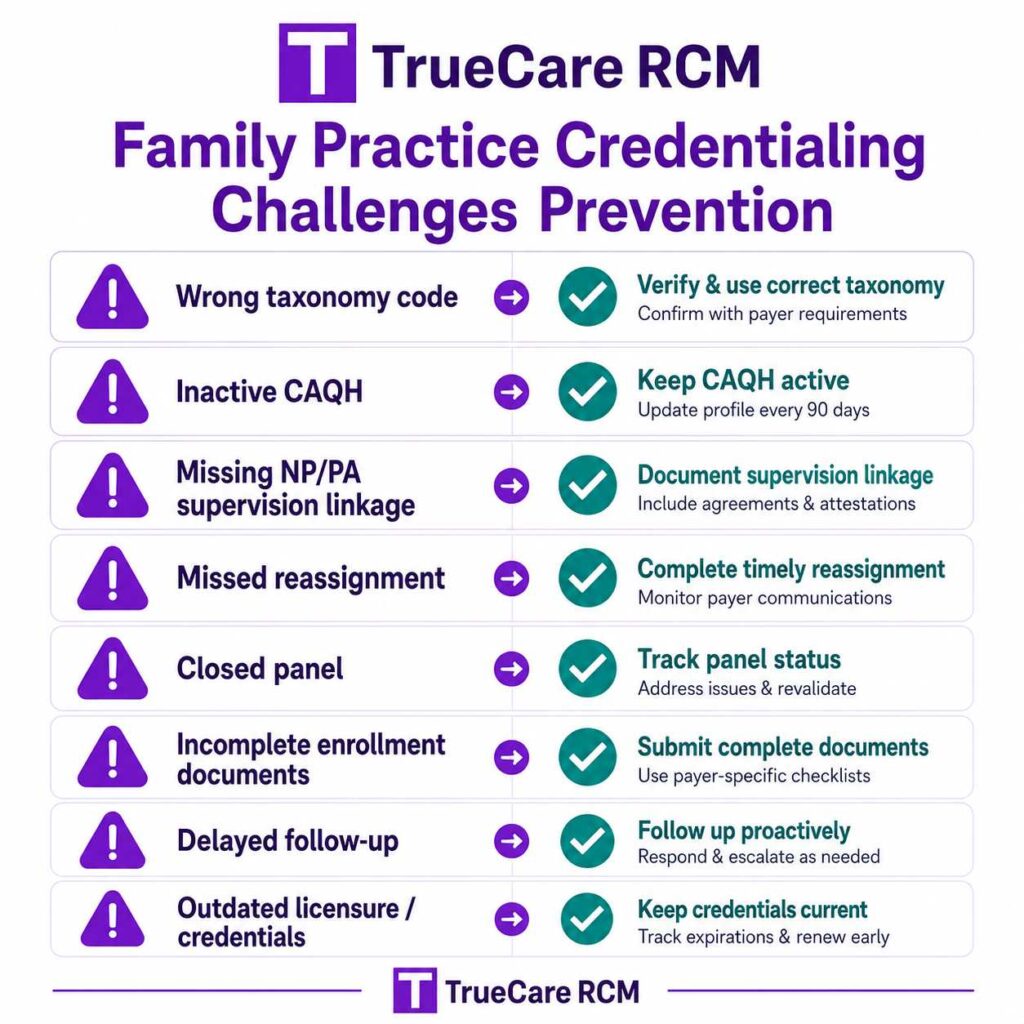
Common Family Practice Credentialing Challenges — And How We Solve Them
These are the most common obstacles that delay family practice credentialing and create revenue gaps — and exactly how TrueCare RCM prevents each one.
| CREDENTIALING CHALLENGE | HOW TRUECARE RCM SOLVES IT |
| Wrong Taxonomy Code — Family physician enrolled under internal medicine or general practice taxonomy instead of 207Q00000X, causing payer directory errors and claim denials | We verify and apply taxonomy code 207Q00000X for every family physician, and the correct NP/PA codes, across PECOS, CAQH, and all payer applications before submission. |
| CAQH Profile Inactive — Re-attestation missed for one provider, stalling every commercial application that relies on that profile across all payers simultaneously | We monitor re-attestation cycles for every provider on your roster and complete CAQH attestation proactively before the 120-day deadline. |
| NP/PA Supervising Physician Linkage Missing — Payer requires documentation of the supervising or collaborating physician relationship, and the application is rejected or claims deny without it | We document and submit the supervising physician relationship as part of every NP and PA credentialing application, and update it whenever supervising arrangements change. |
| New Provider Not Credentialed by Start Date — A newly hired physician, NP, or PA begins seeing patients before any payer enrollment is complete, resulting in weeks of unbillable or out-of-network visits | We start credentialing applications 60-90 days before a confirmed start date — as soon as documentation is available — so providers are enrolled or close to enrolled on day one. |
| Reassignment of Benefits Missing — An individual provider is enrolled with Medicare but not linked to the group NPI, causing claims billed under the group TIN to deny as unverified provider | We complete CMS-855R reassignment of benefits as part of every group enrollment and verify the link is active in PECOS before claims are submitted. |
| Closed Payer Panel — A high-volume commercial payer panel is closed to new family practice providers in a saturated market, blocking a major revenue source | We research panel status before submitting applications. For closed panels, we initiate exception requests with documentation of patient access needs to support panel opening. |
| Revalidation Deadline Missed for One Provider — Medicare or a commercial payer deactivates a single provider’s enrollment due to a missed revalidation, while the rest of the practice stays enrolled — creating confusing partial denials | We maintain a per-provider credentialing expiration calendar across your entire roster. Revalidation is initiated 90-120 days before each individual deadline. |
| Incomplete Application Returned by Payer — A credentialing application is returned for missing signatures, outdated malpractice certificates, or incomplete work history, restarting the review clock | We audit every application for completeness before submission and maintain current copies of malpractice certificates, licenses, and work history for every provider to prevent restarts. |
Family Practice Credentialing Timelines and Our Process
Credentialing timelines for family practice depend on the provider type, the payer, and whether the practice qualifies for delegated credentialing. Below is a realistic breakdown by payer and provider type, along with what protects revenue during the waiting period.
Credentialing Timeline by Payer and Provider Type
| Payer / Provider Type | Standard Timeline | Fastest Possible | Common Delay Causes |
| Medicare Part B (PECOS) — Physician | 60-120 days | 45 days | Missing documents, wrong taxonomy code, MAC backlog |
| Medicare Part B — NP / PA | 60-120 days | 45 days | Missing supervising physician documentation |
| State Medicaid | 60-180 days | 30 days (varies by state) | State portal delays, Medicare-first sequencing |
| Commercial Payers (BCBS, Aetna, UHC, Cigna) | 45-90 days | 30 days | Inactive CAQH, closed panel, contracting delays |
| CAQH ProView Setup | 7-14 days | 3-5 days with specialist | Incomplete education or work history sections |
| Delegated Credentialing (Group) | 15-30 days | 10 days | Incomplete provider roster data, missing primary source documents |
| Medicare Revalidation | 30-60 days | 21 days | Late submission, outdated licensure or insurance docs |
| Commercial Recredentialing | 30-60 days | 21 days | Unresponded info requests, outdated liability coverage |
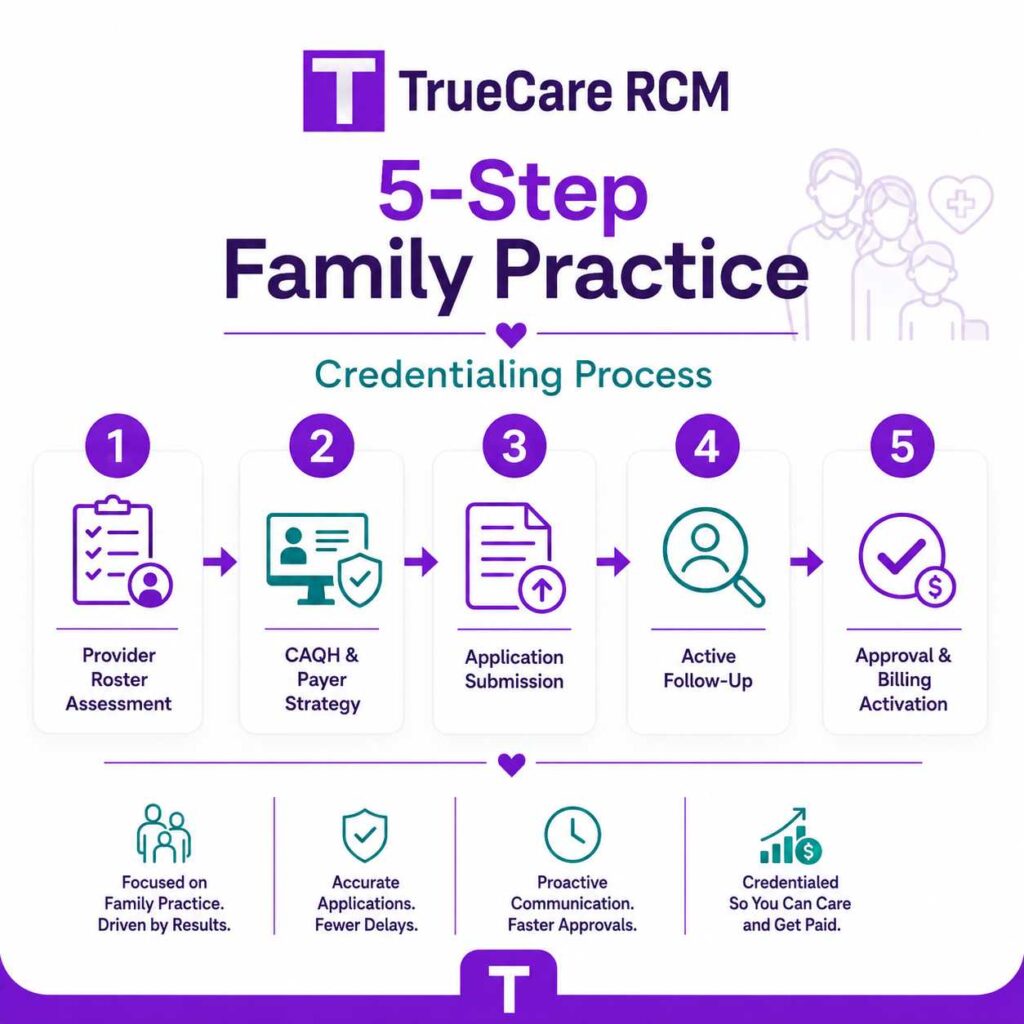
Our Family Practice Credentialing Process — Step by Step
We do not simply submit applications and wait. Our process is structured, tracked, and designed to keep your family practice informed throughout the credentialing lifecycle.
- CAQH profile setup and payer-specific document preparation
- PECOS Medicare enrollment and Medicaid state applications
- Commercial payer credentialing and payer panel follow-up
- NPI, taxonomy, group enrollment, and reassignment review
- Real-time status tracking and escalation for delayed applications
- Approval confirmation and billing activation support
Step – 01
Step – 02
Step – 03
Step – 04
Step – 05
Every Day Without Credentialing Is Lost Revenue
Standard credentialing takes 60-120 days per provider — and every provider waiting is revenue your practice isn’t collecting. TrueCare RCM drives every application forward with proactive follow-up, escalation, and real-time status updates.
Why Family Practices Choose TrueCare RCM for Credentialing
TrueCare RCM combines family medicine-specific enrollment expertise with a proactive, coordinator-driven process that manages every provider type on your team — not just physicians. We know how NP and PA credentialing differs from physician credentialing, how to sequence applications across high payer volumes, and when to escalate a stalled application.
Our credentialing support integrates directly with our billing team — so when a provider’s credentialing is complete, your billing workflow is already in place and claims go out on day one of their effective date.
| What You Get | What That Means for Your Practice |
| Dedicated Credentialing Coordinator | One specialist manages your entire provider roster — you always have a direct contact, not a call center queue |
| Correct Taxonomy for Every Provider Type | 207Q00000X for physicians, plus correct NP and PA codes — verified across every application from day one |
| NP/PA Credentialing Expertise | We manage supervising physician documentation and payer-specific NP/PA requirements that general credentialing teams often miss |
| Proactive Follow-Up Schedule | We contact payers on a defined timeline for every provider — applications never sit idle |
| Billing Integration on Approval | Your billing team is ready for each provider as soon as credentialing is complete — claims go out immediately at their effective date |
| New Hire Onboarding Built In | Credentialing begins 60-90 days before a confirmed start date, minimizing the unbillable window for new providers |
What Our Clients Achieve
| Zero Revenue Gaps — Pending Approval Letters protect retroactive billing rights
Faster New Provider Onboarding — Credentialing starts before the start date No Missed Deadlines — Per-provider revalidation tracked 90 days in advance |
Full Roster Coordination — Physicians, NPs, and PAs managed together, not separately
Broad Payer Coverage — High-volume commercial payer panels prioritized first Billing-Ready Handoff — Claims go out on each provider’s effective date, not weeks later |
Who We Serve in Family Practice Credentialing
Our Family Practice Credentialing Services are designed for providers and organizations that need accurate payer enrollment, organized follow-up, and clear billing activation.
| Practice Type / Audience | How We Help |
|---|---|
| Solo Family Physicians | We manage first-time enrollment with Medicare, Medicaid, CAQH, and commercial payers. |
| New Primary Care Clinics | We support startup credentialing, group NPI setup, tax ID alignment, and payer strategy. |
| Multi-Provider Groups | We track provider onboarding, payer applications, reassignment, and recredentialing. |
| Multi-Location Practices | We manage location updates, payer records, and provider participation by site. |
| Nurse Practitioners | We help with payer enrollment, collaboration documentation, and group billing setup. |
| Physician Assistants | We support payer-specific PA credentialing and supervision requirements. |
| Practice Managers | We reduce administrative workload and provide organized application tracking. |
| Credentialing Coordinators | We provide overflow support, cleanup, payer follow-up, and escalation. |
| Billing & Coding Teams | We confirm payer approvals and effective dates before claim submission begins. |
| Healthcare Administrators | We support scalable credentialing workflows for growing primary care organizations. |
| Group Practice Owners | We help with provider onboarding, tax ID alignment, payer enrollment, and billing readiness. |
| Non-Physician Owners | We organize payer enrollment requirements for provider-led billing and practice operations. |
Frequently Asked Questions About Family Practice Credentialing Services
Family practice credentialing services manage the process of enrolling family physicians, nurse practitioners, and physician assistants with insurance payers — including Medicare, Medicaid, and commercial plans — so the practice can be reimbursed for covered primary care services. This includes CAQH ProView setup, NPI and taxonomy code registration, PECOS enrollment, and ongoing recredentialing for every provider on the team.
Without credentialing, a provider cannot bill payers as an in-network provider, which means visits go unbilled, billed to the patient directly, or processed as out-of-network at a lower reimbursement rate. Because family practices typically see patients across nearly every payer in their market, even a single missing payer credential can affect a significant share of visits.
Standard credentialing takes 60-120 days depending on the payer and provider type. Medicare Part B enrollment typically takes 60-120 days, commercial payers take 45-90 days, and state Medicaid ranges from 60-180 days. CAQH ProView setup takes 7-14 days. Delegated credentialing for qualifying groups can reduce commercial payer timelines to 15-30 days.
Required documents typically include: state medical, NP, or PA license, DEA registration where applicable, malpractice insurance certificate, NPI registration (Type 1 and Type 2), curriculum vitae, proof of education and residency or training completion, work history, and peer references. For NPs and PAs, documentation of the supervising or collaborating physician relationship is also required by many payers.
Yes. CAQH ProView is used by over 1,400 insurers as the foundation for commercial payer credentialing applications. A complete, attested CAQH profile is required before most commercial payers will process a family physician’s credentialing application. The profile must be re-attested every 120 days to remain active.
Credentialing is the verification process where a payer confirms a provider’s qualifications — license, education, certifications, and work history — to determine eligibility for network participation. Payer enrollment is the broader process that includes credentialing plus contracting (agreeing to reimbursement rates and terms) and registering the provider in the payer’s claims system so claims can be processed and paid.
Yes, significantly. Because family practices bill across many payers and provider types, a delay with even one payer or one provider can mean weeks of visits that are unbillable, billed to patients directly, or processed at lower out-of-network rates. New provider credentialing delays are especially costly since the provider may see a full patient schedule with no corresponding in-network reimbursement.
Medicare enrollment is completed through PECOS using Form CMS-855I for individual providers or CMS-855B for group practices, with the correct taxonomy code (207Q00000X for family medicine). Medicaid enrollment is completed separately through each state’s Medicaid portal, and many states require Medicare enrollment to be completed first. TrueCare RCM manages both processes for every provider on your team.
Because family medicine serves as a first point of contact for most patients, family practices typically need to credential with Medicare, Medicaid, and every major commercial payer active in their service area — including BCBS, Aetna, UnitedHealthcare, and Cigna, plus regional plans. TrueCare RCM helps identify which payers are highest-volume in your market and prioritizes those applications first.
Yes. NPs and PAs require their own NPI registration, their own taxonomy codes (typically 363LF0000X for Family Nurse Practitioners and 363A00000X for Physician Assistants), and their own enrollment with each payer. Many commercial payers also require documentation of the supervising or collaborating physician relationship as part of NP and PA credentialing applications.
Most commercial payers require recredentialing every 2-3 years. Medicare requires revalidation every 5 years. CAQH ProView profiles must be re-attested every 120 days. Because these deadlines apply per provider, a multi-provider family practice has multiple overlapping deadlines that must be tracked simultaneously — which is why TrueCare RCM maintains a per-provider expiration calendar.
In most cases, new providers can see patients on a self-pay or cash-pay basis, or issue superbills so patients can seek out-of-network reimbursement, but the practice cannot bill payers as in-network until credentialing is approved. TrueCare RCM helps obtain Pending Approval Letters from Medicare, which can protect retroactive billing rights back to the application submission date once approved.
Many claim denials originate at credentialing — wrong taxonomy codes, missing reassignment of benefits, expired CAQH attestations, or missing supervising physician documentation for NPs and PAs. By ensuring every application is complete and accurate from submission, and by maintaining ongoing compliance with re-attestation and revalidation deadlines, credentialing services prevent the enrollment-related denials that are difficult to fix retroactively.
An incomplete application is typically returned by the payer, restarting the review timeline from the point of resubmission — adding weeks or months to the process. Common causes include missing signatures, outdated malpractice certificates, incomplete work history, or missing NP/PA supervising physician documentation. TrueCare RCM audits every application for completeness before submission to avoid these restarts.
Credentialing for a family practice involves managing multiple provider types, high payer volumes, and overlapping recredentialing deadlines — all while staying current on requirements that vary by payer and state. Outsourcing to a specialist team like TrueCare RCM means applications are submitted correctly the first time, deadlines are tracked proactively across your entire roster, and new providers can begin billing in-network sooner.
Outsourcing family practice credentialing helps reduce administrative workload, avoid application mistakes, improve payer follow-up, and keep billing teams informed about approval and effective dates. For busy primary care clinics, outsourcing allows providers and staff to focus more on patient care and practice operations.
Start Your Family Practice Credentialing Process Today
Avoid payer enrollment delays, incomplete applications, and revenue disruption. TrueCare RCM helps family physicians, nurse practitioners, physician assistants, group practices, and healthcare administrators complete credentialing with accuracy and confidence.
From CAQH and PECOS to Medicare, Medicaid, commercial payers, recredentialing, and billing activation, our team manages the details so your practice can focus on patient care.

Family Practice Credentialing Documentation Checklist
Before a single payer application is submitted, every provider and practice document should be complete, current, and consistent. Missing or outdated documents are among the most common causes of credentialing delays.
- MD, DO, NP, or PA professional documentation
- Current CV with complete work history
- Medical school, residency, or professional training information
- Board certification, if applicable
- Professional references, if required by payer
- Explanation letters for work history gaps, malpractice history, or adverse actions, if applicable
- Current state medical license or professional license
- NPI Type 1 for individual provider
- NPI Type 2 for group practice, if applicable
- DEA certificate, if applicable
- State controlled substance registration, if required
- Medicare enrollment information, if applicable
- Medicaid enrollment information, if applicable
- Legal business name
- DBA name, if applicable
- EIN / Tax ID confirmation
- W-9 form
- Practice address and billing address
- Phone, fax, and administrative contact details
- Ownership information, if required
- Authorized official or practice manager information
- Group roster, if applicable
- Malpractice insurance certificate
- Tail coverage documentation, if applicable
- Professional liability details
- OIG exclusion check information, if required
- NPDB-related disclosures, if applicable
- Background or disclosure forms required by payer
- CAQH login and attestation access
- PECOS access or authorization
- Payer portal access
- Commercial payer applications
- Medicaid application forms
- EFT and ERA enrollment information
- Reassignment of benefits documents
- Provider agreement signatures
- Effective date confirmation
Family Practice Credentialing Glossary – Key Terms Explained
| Term | Definition |
| PECOS | Provider Enrollment, Chain, and Ownership System — the CMS online portal for Medicare provider enrollment. Used to complete CMS-855I (individual) and CMS-855B (group) enrollment applications for physicians, NPs, and PAs. |
| CAQH ProView | Centralized credentialing database used by over 1,400 insurers. Providers complete one profile and authorize payers to access it. Requires re-attestation every 120 days to remain active. |
| Taxonomy Code 207Q00000X | Standard NUCC taxonomy code for family medicine physicians. Must be applied consistently across NPI, PECOS, CAQH, and all payer applications to prevent directory errors and claim denials. |
| NP/PA Taxonomy Codes | Nurse Practitioners and Physician Assistants use their own taxonomy codes — commonly 363LF0000X for Family Nurse Practitioners and 363A00000X for Physician Assistants — separate from the physician’s family medicine code. |
| NPI Type 1 | National Provider Identifier for individual healthcare providers. Used on all Medicare, Medicaid, and commercial payer claims and applications for each physician, NP, and PA individually. |
| NPI Type 2 | National Provider Identifier for organizations and group practices. Individual provider NPIs must be linked to the group NPI via reassignment of benefits (CMS-855R). |
| Reassignment of Benefits | Process by which an individual provider authorizes Medicare to pay their employer or group practice. Completed via CMS-855R in PECOS. Required for all providers billing under a group NPI. |
| Delegated Credentialing | An arrangement where a payer delegates primary source verification responsibilities to a practice or its credentialing partner, significantly shortening enrollment timelines for new providers in qualifying groups. |
| Primary Source Verification | The process of verifying a provider’s credentials — license, education, board certification — directly with the issuing institution rather than relying on the provider’s self-reported information. |
| MAC (Medicare Administrative Contractor) | Private company contracted by CMS to process Medicare claims and enrollment applications in a specific geographic region. Reviews, approves, or rejects PECOS applications. |
| EFT | Electronic Funds Transfer — electronic bank payment of Medicare and payer reimbursements. Enrolled via CMS-588 in PECOS. Eliminates paper checks and enables faster payment posting. |
| Credentialing vs. Payer Enrollment | Credentialing verifies a provider’s qualifications to join a network. Payer enrollment is the broader process including credentialing plus contracting and registration in the payer’s claims system so claims can be paid. |