
At TrueCare RCM, we provide specialized credentialing and enrollment solutions built for Ambulatory Surgical Centers (ASCs). Whether you’re launching a new multi-specialty surgery center, adding a service line, or managing payer enrollment across an established facility, we handle every step of your Medicare certification, Medicaid enrollment, and commercial payer contracting — so you get approved faster and get paid without gaps.
Complete Payer Enrollment & Credentialing Support for Ambulatory Surgical Centers
ASC Credentialing Services That Get Your Surgery Center Billing Faster
What’s included:
✅ Medicare CMS-855B enrollment and certification support via PECOS
✅ State licensure and Medicare Conditions for Coverage compliance support
✅ Commercial and managed care payer contracting — BCBS, Aetna, UHC, Cigna & more
✅ Type 2 organizational NPI setup and taxonomy verification
✅ Individual provider credentialing coordination for surgeons and anesthesiologists
✅ Proactive follow-up and escalation — we drive every application to approval
Ambulatory Surgical Center (ASC) Credentialing Services
ASC credentialing services manage Medicare CMS-855B certification, PECOS enrollment, state licensure coordination, Medicaid enrollment, and commercial payer contracting for Ambulatory Surgical Centers. TrueCare RCM handles every step — from facility certification through individual provider credentialing — so your ASC gets approved faster and bills without revenue gaps.
Complete Payer Enrollment and Credentialing Support for Ambulatory Surgical Centers
ASC credentialing is fundamentally different from physician credentialing. An ASC must first achieve Medicare certification — a facility-level process involving a state survey or deemed-status accreditation and CMS Conditions for Coverage compliance — before facility-level payer enrollment can even begin. On top of this, every surgeon, anesthesiologist, and CRNA practicing at the facility needs their own individual credentialing, run as a separate but parallel track.
At TrueCare RCM, we understand this dual-layer reality. We manage the full sequence: Medicare certification and PECOS enrollment (CMS-855B), state licensure coordination, Medicaid enrollment, and commercial payer contracting for the facility — while also coordinating individual provider credentialing for every clinician practicing at the center.
60–180 Days
Medicare Certification & PECOS
45–120 Days
Medicaid & Commercial Payers
100%
Dedicated Credentialing Support
Zero Revenue Gaps
With Effective Date Tracking
Nationwide Support
Credentialing Help Across Priority U.S. States
Credentialing Solutions Tailored for Ambulatory Surgical Centers
Our credentialing services are built for the real-world needs of ASCs — from first-time Medicare certification to ongoing payer panel maintenance and individual provider coordination.
✔ Medicare Certification & CMS-855B Enrollment
Complete CMS-855B enrollment via PECOS, coordinated with the state survey or deemed-status accreditation process required for Medicare certification — the foundational step before any ASC billing can begin.
✔ State Licensure & Conditions for Coverage Compliance
Guidance through state-specific ASC licensure requirements and CMS Conditions for Coverage, which must typically be met before or alongside Medicare certification.
✔ State Medicaid Enrollment
All-state Medicaid enrollment with state-specific knowledge of requirements, processing timelines, and managed Medicaid plan contracting.
✔ Commercial & Managed Care Payer Contracting
Full enrollment and contracting with BCBS, Aetna, UHC, Cigna, Humana, and regional managed care organizations relevant to your service area and surgical specialties.
✔ Type 2 NPI & Taxonomy Verification
Organizational NPI registration and verification of the correct ASC taxonomy code across PECOS, state Medicaid, and every payer application.
✔ Individual Provider Credentialing Coordination
Coordination of credentialing for surgeons, anesthesiologists, and CRNAs practicing at the facility — run alongside, not instead of, the facility’s own credentialing.
✔ Change of Ownership (CHOW) & Change of Information Support
Coordination of Medicare and Medicaid filings required when ownership changes, service lines are added, or other facility information updates need to be reported.
✔ Revalidation Management
Proactive tracking of Medicare revalidation cycles and state Medicaid re-enrollment deadlines so your ASC never loses billing privileges.

Why Ambulatory Surgical Centers Choose TrueCare RCM for Credentialing
ASC credentialing spans two layers that most generalist credentialing services don’t separate clearly: facility-level Medicare certification and payer contracting, and individual provider credentialing for every surgeon, anesthesiologist, and CRNA practicing at the center. New or growing ASCs often face overlapping timelines between facility certification and physician privileging that, if mismanaged, can stall the center’s ability to open or expand service lines by months.
At TrueCare RCM, we manage every detail from day one — facility Medicare certification, Medicaid and commercial payer contracting, and coordinated individual provider credentialing — so your ASC starts performing billable procedures without revenue gaps.
Our ASC Credentialing Process — Step by Step
We do not simply submit applications and wait. Our process is structured, tracked, and designed to keep your facility informed throughout the entire credentialing and certification lifecycle.
- State licensure verification and application support
- CMS-855B Medicare certification enrollment via PECOS
- State survey or accreditation readiness coordination
- Medicaid and managed care payer applications
- Real-time status tracking and escalation for delayed applications
- Approval confirmation and billing activation support
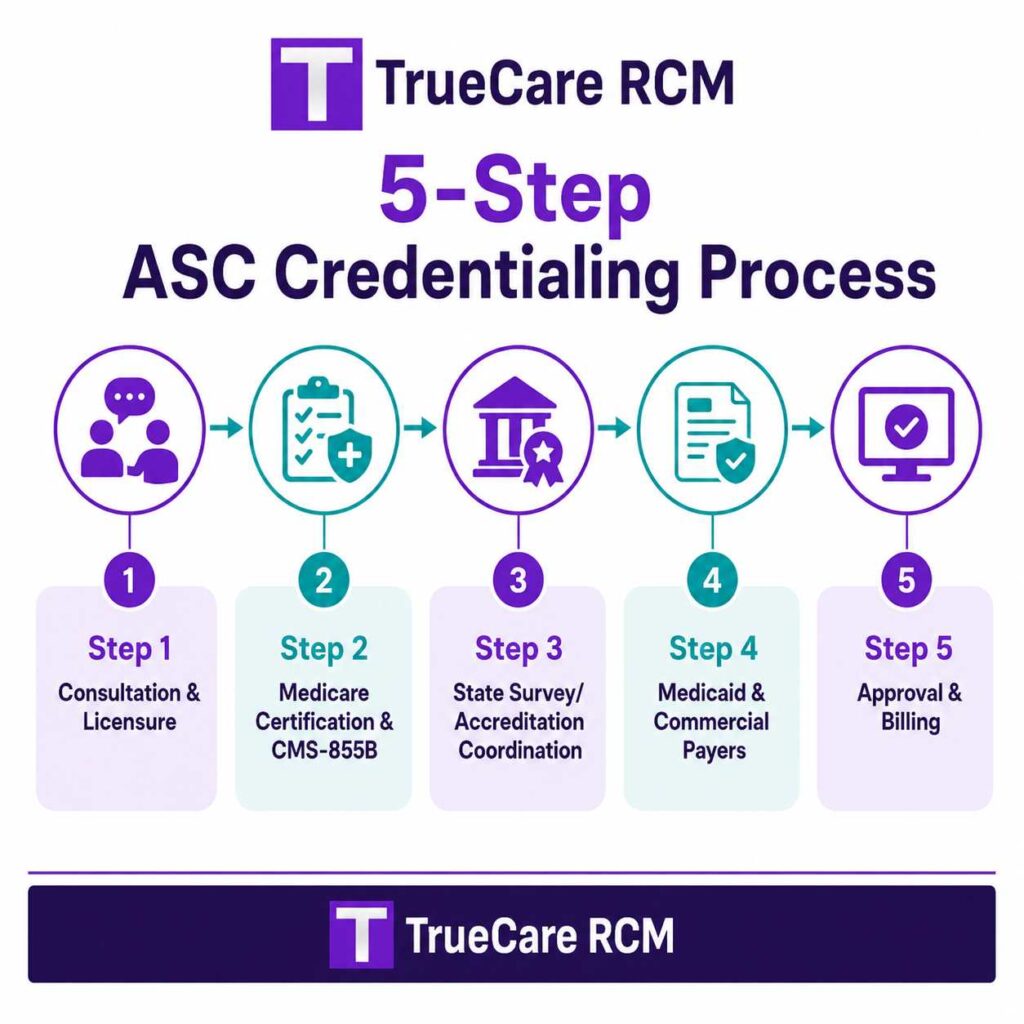
Step – 01
Step – 02
Step – 03
Step – 04
Step – 05
How Long ASC Credentialing Takes — Realistic Timelines
Credentialing and certification timelines for ASCs depend heavily on state survey or accreditation scheduling, and payer type. Here’s what to realistically plan for:
| Process / Payer Type | Typical Timeline | Notes |
| State Licensure | 30–90 days | Varies significantly by state; some states require Certificate of Need approval, adding significant time |
| Medicare Certification (CMS-855B + Survey) | 90–180 days | Includes state survey or deemed-status accreditation (AAAHC, AAAASF, or Joint Commission) scheduling, often the longest bottleneck |
| State Medicaid | 60–120 days | State-specific variation; often cannot begin until Medicare certification is in place |
| Commercial & Managed Care Payers | 45–120 days | Dependent on payer panel status and contracting backlog |
| Individual Provider Credentialing (Surgeons, Anesthesia) | 60–120 days | Runs in parallel with facility certification; both must be complete before a provider’s cases are billable in-network |
| Medicare Revalidation | 60–90 days | Required periodically per CMS schedule; missed deadlines deactivate billing privileges |
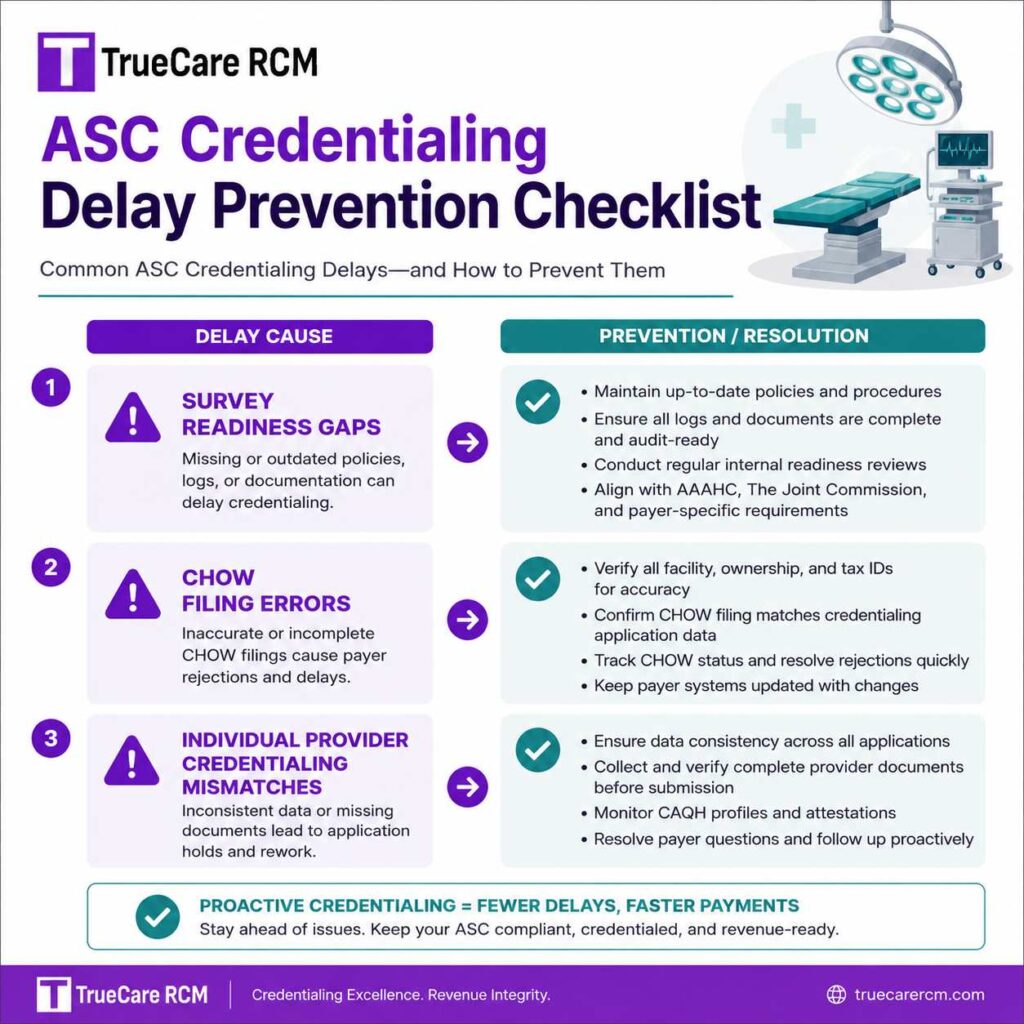
Common ASC Credentialing Delays — And How We Prevent Them
Most delays are preventable. Here’s what typically derails ASC credentialing, and exactly what we do about it:
| Common Delay | How TrueCare RCM Prevents It |
| Facility not survey-ready when state inspector or accreditor arrives | We help align documentation, staffing records, and policies with CMS Conditions for Coverage well ahead of the scheduled survey or accreditation visit |
| CMS-855B application returned for missing ownership disclosures | We audit ownership, authorized official, and delegated official information for completeness before submission |
| Individual provider credentialing lagging behind facility certification | We coordinate both tracks simultaneously so surgeons and anesthesiologists are credentialed in parallel with the facility, not after |
| Medicaid application filed before Medicare certification is complete | We sequence applications correctly — most states require Medicare certification before Medicaid enrollment can proceed |
| Change of Ownership (CHOW) filed incorrectly, creating a billing gap | We manage CHOW filings end-to-end, including all required CMS notifications, to minimize the gap between ownership transfer and billing resumption |
| Missed Medicare revalidation deadline | We track your facility’s revalidation cycle and file well before the deadline to avoid billing privilege deactivation |
| Commercial payer panel closed in a saturated market | We research panel status before applying and pursue network adequacy exceptions where applicable |
Who We Serve in ASC Credentialing
Our ASC credentialing services support facilities of every size and surgical specialty mix — from new single-specialty centers to established multi-specialty surgical organizations.
| Facility Type | How We Help |
| New ASC Startups | Full credentialing built from zero — state licensure, Medicare certification, and payer enrollment coordinated from day one |
| Multi-Specialty Surgery Centers | Coordinated credentialing across multiple surgical specialties and the providers practicing in each |
| Orthopedic Surgery Centers | Facility and individual surgeon credentialing tailored to orthopedic procedure billing |
| Pain Management ASCs | Facility credentialing coordinated with interventional pain physician privileging |
| Ophthalmology & GI Surgery Centers | Specialty-specific facility credentialing for high-volume outpatient procedure centers |
| ASCs Undergoing Change of Ownership | CHOW filings managed end-to-end to minimize billing disruption during ownership transitions |
Frequently Asked Questions About ASC Credentialing Services
Everything Ambulatory Surgical Centers need to know about credentialing and certification — answered directly.
ASC credentialing services manage the process of certifying a surgical facility with Medicare, enrolling with state Medicaid programs, and contracting with commercial payers. This includes CMS-855B enrollment via PECOS, state licensure coordination, Type 2 NPI registration, and coordination of individual provider credentialing for surgeons and anesthesiologists.
Without Medicare certification and payer enrollment, an ASC cannot bill for facility fees. Medicare requires institutional certification — including a state survey or deemed-status accreditation — before any ASC claims can be submitted.
Credentialing/certification verifies the facility meets regulatory and quality standards (Medicare Conditions for Coverage, state licensure). Enrollment registers the facility in a payer’s claims system. Payer contracting establishes the reimbursement rates and terms. All three are required before billing.
Medicare certification, including CMS-855B enrollment and the state survey or accreditation process, typically takes 90–180 days. State Medicaid enrollment takes 60–120 days and often cannot begin until Medicare certification is complete. Commercial payer contracting ranges 45–120 days.
Required documentation includes: legal business formation documents, ownership and authorized official disclosures, state ASC license, CMS-855B application, clinical staffing and policy documentation for survey readiness, professional and general liability insurance, and EIN/W-9 information.
Yes. Medicare certification — which includes meeting the Conditions for Coverage and passing a state survey or deemed-status accreditation review (AAAHC, AAAASF, or Joint Commission) — is mandatory before an ASC can bill Medicare for facility fees.
Yes. CMS-855B is the Medicare enrollment application specific to institutional providers like ASCs. TrueCare RCM manages the full PECOS submission, including ownership disclosures and the coordination needed alongside your state survey or accreditation process.
Yes. Facility-level Medicare certification and payer enrollment is separate from individual provider credentialing. Every surgeon, anesthesiologist, and CRNA practicing at the ASC needs their own credentialing with payers, run alongside the facility’s own enrollment.
Yes. In addition to Medicare certification, ASCs need to be credentialed and contracted with commercial insurance payers at the facility level — separate from the individual credentialing of the surgeons and anesthesiologists who practice there.
This depends on your service area and surgical specialty mix, but typically includes major commercial payers (BCBS, Aetna, UHC, Cigna, Humana), Medicare Advantage plans, and Medicaid managed care organizations operating in your state.
Yes. State Medicaid enrollment is a core part of our service. Most states require Medicare certification to be completed first, and TrueCare RCM sequences applications correctly to avoid unnecessary rejections.
Common causes include facilities not being survey-ready when the state inspector or accreditor arrives, incomplete ownership disclosures on CMS-855B, individual provider credentialing lagging behind facility certification, Medicaid applications filed before Medicare certification is complete, and Change of Ownership filings submitted incorrectly.
Every day without Medicare certification or payer enrollment is a day the facility cannot bill for procedures performed — regardless of surgical volume. This makes credentialing the single biggest determinant of when a new ASC or new service line starts generating revenue.
Medicare requires periodic revalidation on a CMS-determined schedule. Commercial and Medicaid managed care payers typically recredential every 2–3 years. Individual providers practicing at the facility have their own separate recredentialing cycles.
ASC certification involves coordinating state licensure, Medicare’s institutional enrollment process, a state survey or accreditation review, multiple payer applications, and individual provider credentialing simultaneously. Outsourcing to TrueCare RCM means every step is sequenced correctly and tracked proactively — minimizing the unbillable window between opening and first reimbursement.
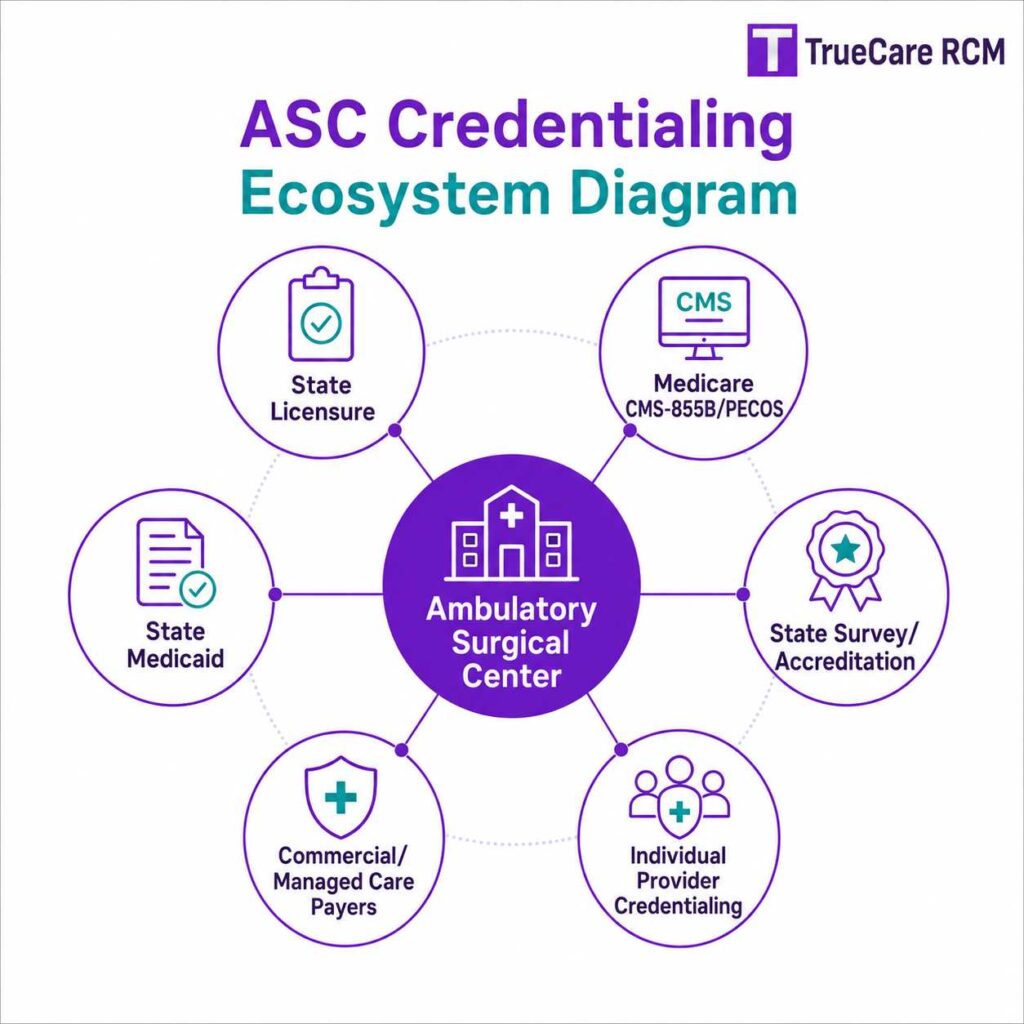
Why ASC Credentialing Matters for Facility Revenue
ASC credentialing is unlike physician credentialing in one critical way: the facility itself must achieve institutional certification — a process involving regulatory compliance, a state survey or accreditation review, and Medicare’s Conditions for Coverage — while every individual provider practicing there needs separate, coordinated credentialing. Misunderstanding this dual-layer sequence is the single most common cause of costly delays for new and growing ASCs.
Unlike physician credentialing, ASC billing begins with institutional Medicare certification via CMS-855B — which requires passing a state survey or achieving deemed status through an accrediting organization like AAAHC, AAAASF, or Joint Commission. Nothing else can proceed until this step is complete.
ASC credentialing requires two coordinated tracks: facility-level Medicare certification and payer contracting, and individual credentialing for every surgeon, anesthesiologist, and CRNA practicing at the center. Both must be complete before a provider’s cases are billable in-network.
Many states require ASC licensure — and in some cases a separate Certificate of Need approval — before Medicare certification can even be pursued. These state-level requirements vary enormously and are often the least-understood part of the launch timeline.
Most state Medicaid programs require a facility to be Medicare-certified before Medicaid enrollment can proceed. ASCs that attempt to file Medicaid applications too early routinely see them rejected, adding unnecessary delay.
A Change of Ownership (CHOW) requires new Medicare enrollment processing under CMS rules. ASCs that don’t manage this transition carefully can experience a real gap in billing ability during an ownership change — even though surgical operations continue uninterrupted.
New ASC launches routinely underestimate how long the survey or accreditation step takes, since it depends on external scheduling outside any credentialing team’s direct control. TrueCare RCM helps facilities set realistic launch timelines from day one — avoiding the costly mistake of scheduling surgical cases before certification is realistically in sight.
ASC Credentialing Documentation Checklist
Before a single application is submitted, every facility and compliance document needs to be in place. Here’s the full checklist we work through for every Ambulatory Surgical Center we credential:
Business & Ownership Documentation
- Legal business name and formation documents
- EIN / Tax ID confirmation and W-9 form
- Ownership disclosure and organizational chart
- Authorized official and delegated official information
Licensing & Certification
- State Ambulatory Surgical Center license (and Certificate of Need, if required by state)
- CMS-855B Medicare enrollment application
- Accreditation documentation (AAAHC, AAAASF, or Joint Commission), if pursuing deemed status
- State survey readiness documentation
Operational & Clinical Documentation
- Clinical staffing records and personnel qualifications
- Policies and procedures aligned with CMS Conditions for Coverage
- Infection control and patient safety documentation
- Surgical specialty service line documentation
Insurance & Compliance
- Professional and general liability insurance certificates
- CLIA certificate, if performing any laboratory testing
- Workers’ compensation coverage documentation
Payer Enrollment Documentation
- Type 2 organizational NPI registration
- EFT enrollment and banking validation information
- State Medicaid application materials
- Commercial and managed care payer contracting documents
- Individual provider credentialing files for surgeons, anesthesiologists, and CRNAs
ASC Credentialing Glossary — Key Terms Explained
| Term | Definition |
| CMS-855B | The Medicare enrollment application for institutional providers, including Ambulatory Surgical Centers, submitted via PECOS. |
| Medicare Certification | The process by which an ASC demonstrates compliance with CMS Conditions for Coverage, typically through a state survey or deemed-status accreditation. |
| Conditions for Coverage | CMS regulatory standards that ASCs must meet to be certified for Medicare participation, covering clinical, operational, and quality requirements. |
| Deemed Status / Accreditation | Certification achieved through an approved accrediting organization (AAAHC, AAAASF, or Joint Commission) as an alternative to the standard state survey process. |
| Type 2 NPI | The organizational National Provider Identifier used for institutional billing by the ASC entity, distinct from individual provider NPIs. |
| Change of Ownership (CHOW) | A CMS-defined event requiring new Medicare enrollment processing when an ASC changes ownership, which can create a billing gap if not managed carefully. |
| EFT Enrollment | Electronic Funds Transfer setup required to receive Medicare and payer reimbursements directly via bank deposit rather than paper check. |
| Individual Provider Credentialing | The separate, coordinated process of credentialing surgeons, anesthesiologists, and CRNAs who practice at the ASC, distinct from the facility’s own institutional certification. |
| Revalidation | Periodic re-verification of an ASC’s Medicare enrollment information, required on a CMS-determined schedule to maintain billing privileges. |
| Managed Care Organization (MCO) | A health plan, often contracted by a state Medicaid program, requiring separate payer enrollment and contracting from standard fee-for-service Medicaid. |
Get Started with ASC Credentialing Today
Avoid certification delays, incomplete applications, and revenue disruption. TrueCare RCM helps Ambulatory Surgical Centers of every size complete Medicare certification, state licensure, Medicaid enrollment, commercial payer contracting, and individual provider credentialing coordination with accuracy and confidence.
From CMS-855B and PECOS to state surveys, Medicaid, commercial payers, and revalidation — our team manages the details so your facility can focus on patient care. Contact us today for a free credentialing consultation.