
Dermatology credentialing services handle the complex process of verifying your qualifications with insurance payers so you can bill for services. With specialized requirements for cosmetic, medical, and surgical dermatology procedures, professional credentialing typically takes 90-120 days and includes CAQH setup, Medicare/Medicaid enrollment, and commercial payer credentialing. Outsourcing to experts eliminates costly delays and gets you billing faster.
Table of Contents
- What Dermatology Credentialing Services Actually Include
- Why Dermatology Credentialing Is Different
- How Long Does Dermatology Credentialing Take?
- Essential Documents for Dermatology Credentialing
- CAQH Credentialing for Dermatologists
- Seeing Patients Before Credentialing Is Complete
- Insurance Companies That Require Credentialing
- Medicare and Medicaid for Dermatologists
- Credentialing vs. Enrollment Explained
- Multi-Location and Tele-Dermatology Credentialing
- Common Delays and How to Avoid Them
- Should You Outsource Dermatology Credentialing?
- Frequently Asked Questions
What Are Dermatology Credentialing Services? (More Than Just Paperwork)
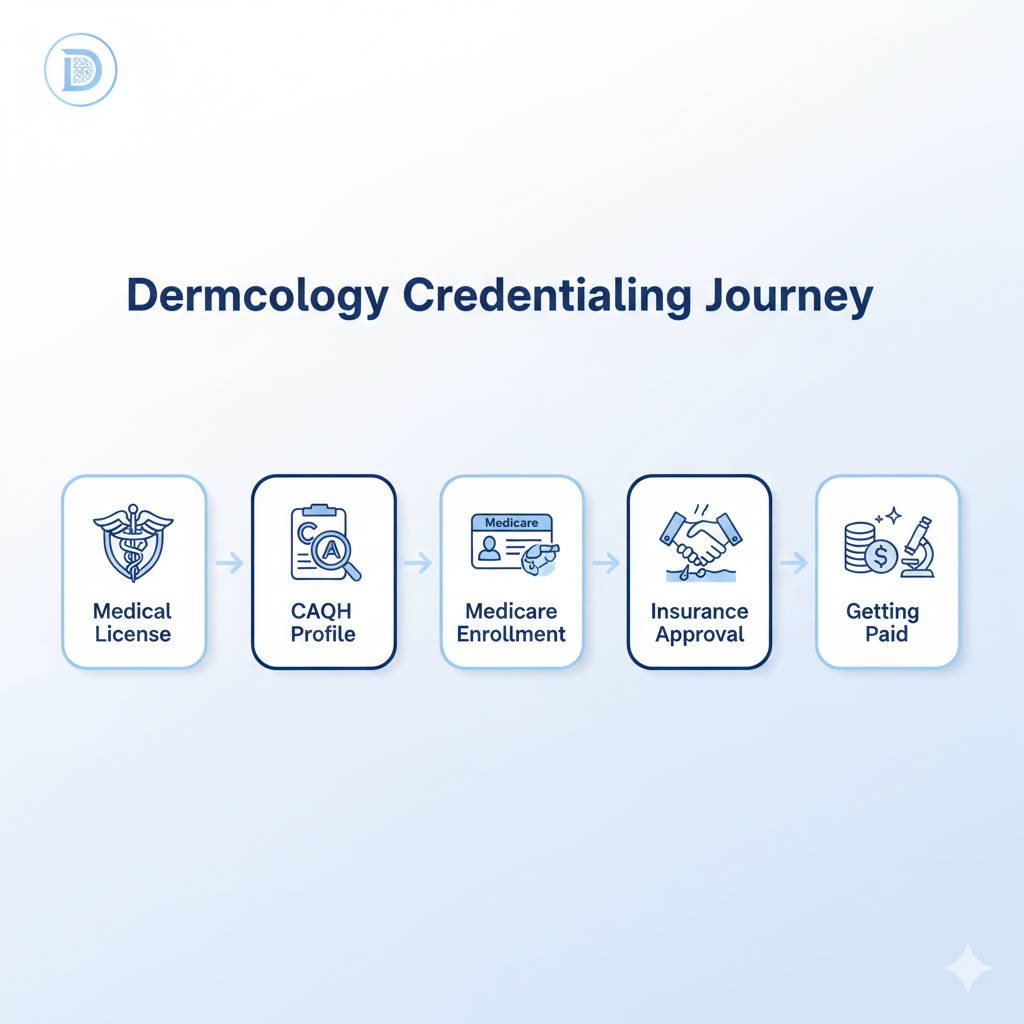
Dermatology credentialing services are specialized providers who handle the entire verification and enrollment process that allows you to bill insurance companies for your services. Think of them as your administrative advocates who navigate the Byzantine world of payer requirements so you don’t have to.
Here’s what comprehensive dermatology credentialing services actually include:
Complete application management for every insurance payer you want to work with—BCBS, Aetna, Cigna, UnitedHealthcare, Humana, and all the regional players. They know exactly what each payer requires and how to submit applications that don’t get kicked back.
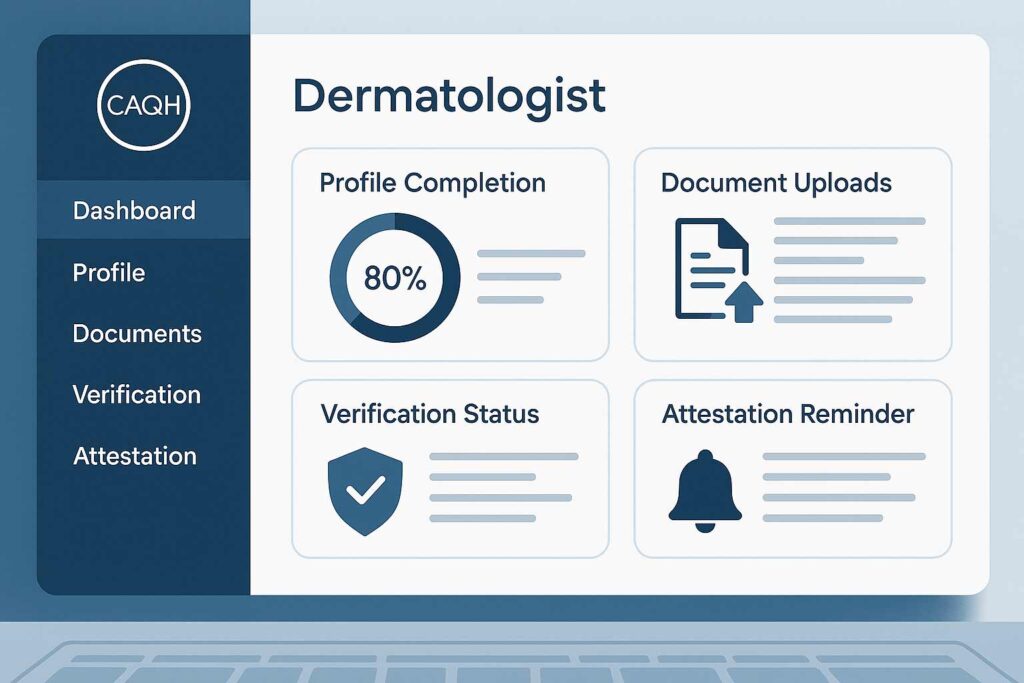
CAQH profile creation and maintenance where they build your universal credentialing database, upload all supporting documents, and ensure it stays attested every 120 days so payers can access your information.
Medicare PECOS enrollment that gets you set up to see Medicare patients, which is non-negotiable for most dermatology practices given the demographic.
State Medicaid credentialing across whatever states you practice in, because Medicaid requirements vary wildly and missing state-specific nuances causes massive delays.
Follow-up and status tracking where they’re calling payers weekly to check on your applications instead of you sitting on hold for 45 minutes to reach someone who can’t help you anyway.
Document verification support to ensure everything from your board certification to your malpractice insurance meets payer requirements before submission.
Recredentialing management so you never miss a revalidation deadline that would terminate your network participation and tank your revenue.
For dermatologists, this matters even more because you’re often dealing with both medical and cosmetic procedures, which sometimes require different credentialing approaches or payer contracts.
Why Dermatology Credentialing Is Different (And More Complex Than You Think)
You might wonder: isn’t credentialing just credentialing? Not exactly. Dermatology has specific wrinkles that complicate the process.
The Medical vs. Cosmetic Divide
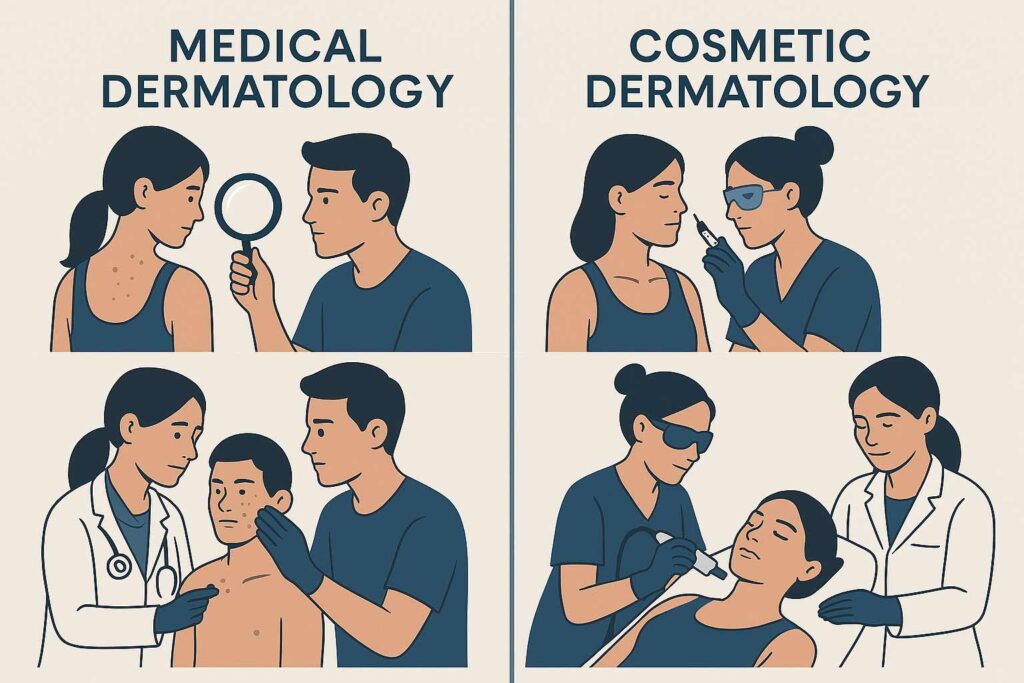
This is the big one. Many dermatologists offer both medical dermatology (treating acne, eczema, skin cancer) and cosmetic procedures (Botox, fillers, laser treatments). Insurance credentialing typically only covers medically necessary services.
Here’s where it gets tricky: some payers require separate documentation or even separate provider agreements if you’re offering cosmetic services alongside medical ones. You need to clearly delineate what services fall under insurance billing versus what you’re offering as self-pay.
Mohs Surgery Credentialing
If you’re performing Mohs micrographic surgery, you’re facing additional credentialing hurdles. Payers often require:
- Specific Mohs surgery fellowship training documentation
- Facility credentialing for your surgical suite
- Additional malpractice coverage verification
- Compliance with ACMS (American College of Mohs Surgery) standards
Some insurers limit Mohs surgery to specific providers within their network, so getting on these panels can take longer.
Dermatopathology Considerations
Dermatologists who read their own pathology slides need credentialing for both clinical dermatology and laboratory services. This means:
- CLIA certification for your lab
- CAP accreditation (if applicable)
- Separate billing provider numbers for pathology services
- Additional documentation requirements
Procedure-Specific Requirements
Certain dermatology procedures trigger additional scrutiny:
- Laser treatments often require specific training certificates
- Chemical peels and advanced aesthetics may need procedure logs
- Excisions and biopsies require facility compliance verification
Bottom line: Generic credentialing services might miss these dermatology-specific requirements, causing denials or delays that specialty-focused services would catch immediately.
How Long Does Dermatology Credentialing Take? (The Honest Timeline)
Let’s cut through the BS: dermatology credentialing takes longer than anyone tells you upfront.
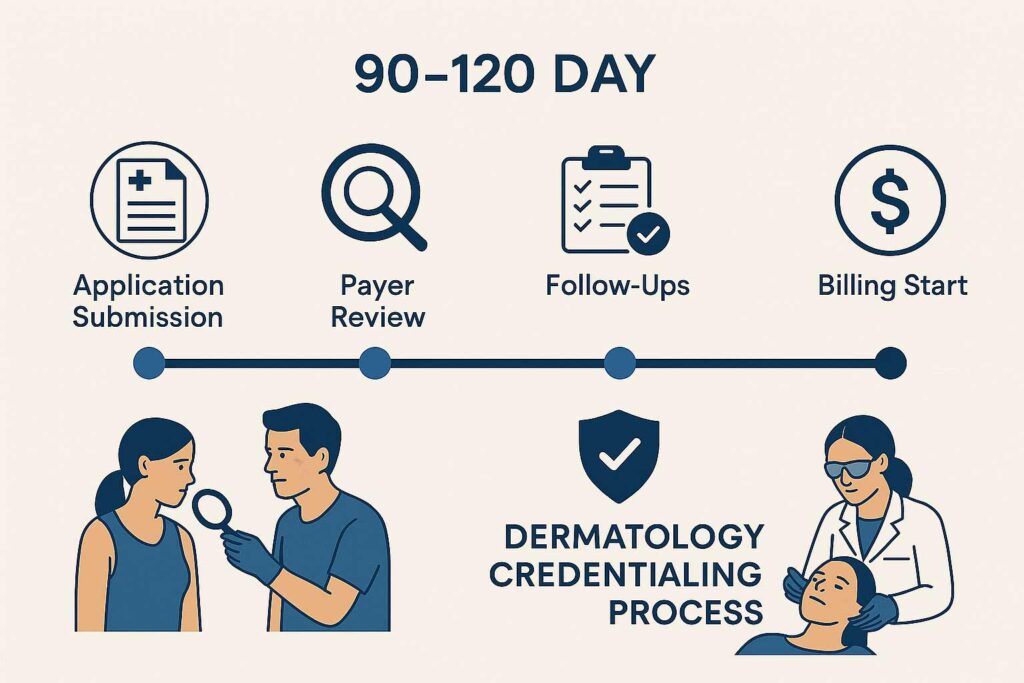
Standard timeline: 90-120 days from application submission to final approval. But here’s what that actually looks like in practice:
| Payer Type | Typical Timeline | Dermatology-Specific Factors |
| Medicare (PECOS) | 60-90 days | Add 2-4 weeks if including surgical facility |
| Medicaid | 90-120 days | Varies significantly by state; faster in TX, slower in CA |
| BCBS Plans | 90-120 days | Additional time if Mohs or derm path |
| UnitedHealthcare | 90-120 days | Strict on malpractice limits |
| Aetna | 90-120 days | Requires detailed procedure lists |
| Cigna | 90-120 days | Fast-track available for high-demand areas |
| Regional Plans | 60-150 days | Highly variable |
But wait, there’s more. These timelines assume:
- Your CAQH profile is complete and attested
- All documents are current and correct
- Your references respond quickly
- The payer isn’t experiencing backlogs
- You don’t need any facility credentialing
In reality, add 30-60 days to these estimates for new dermatology practices. First-time applicants always face more scrutiny.
The Real-World Timeline for New Dermatology Practices
Month 1: Set up NPI, create CAQH profile, gather all documents
Month 2: Submit applications to top 5-7 payers
Month 3: Follow-ups begin, respond to requests for additional info
Month 4: First approvals start coming through (typically Medicaid or smaller regional plans)
Month 5: Major commercial payers approve
Month 6: Medicare approval, stragglers finish up
That’s six months from start to finish if everything goes smoothly. And it rarely goes smoothly.
For established dermatologists adding new locations or new providers to existing practices, timelines can be shorter (60-90 days) since the practice infrastructure already exists.
What Documents Are Required for Dermatology Credentialing? (The Complete Checklist)
Missing even one document restarts the clock. Here’s everything you need, organized by category:
Core Professional Credentials
- Medical degree (MD or DO) from accredited institution
- Dermatology residency completion certificate
- Board certification from American Board of Dermatology
- Fellowship certificates (if applicable—Mohs, dermatopathology, cosmetic)
- State medical license (current and active)
- DEA certificate (if prescribing)
- State controlled substance registration
- NPI (National Provider Identifier)
Specialized Dermatology Documentation
- Mohs surgery fellowship certificate (if applicable)
- ACMS membership verification (for Mohs surgeons)
- Dermatopathology certification (if reading slides)
- CLIA certificate (if operating in-office lab)
- Laser safety training certificates
- Cosmetic procedure training documentation
Malpractice Insurance
- Professional liability insurance ($1M/$3M minimum, some require higher)
- Tail coverage if switching from previous employment
- Certificate of insurance with current dates
- Procedures covered under policy (critical for cosmetic work)
Practice Information
- Practice name and legal entity documents
- Tax ID (EIN)
- Physical practice address (no P.O. boxes)
- Office hours and patient capacity
- Hospital privileges (if applicable—less common for dermatologists)
Work History
- Complete employment history for past 10 years
- CV or résumé in standard format
- Three professional references (dermatologist colleagues preferred)
- Explanation letters for any employment gaps
Background Verification
- NPDB self-query report
- State medical board verification
- OIG/SAM screening clearance
- Medicare opt-out status declaration (if applicable)
CAQH-Specific Items
- Professional headshot (business appropriate)
- Practice liability face sheet
- W-9 for tax purposes
- Attestation signature and date
Pro tip for dermatologists: Keep separate folders for medical dermatology versus cosmetic credentials. When payers ask about your scope of practice, you can quickly provide relevant documentation without overwhelming them with unrelated certificates.

Do Dermatologists Need CAQH Credentialing? (Yes, and Here’s the Setup Process)
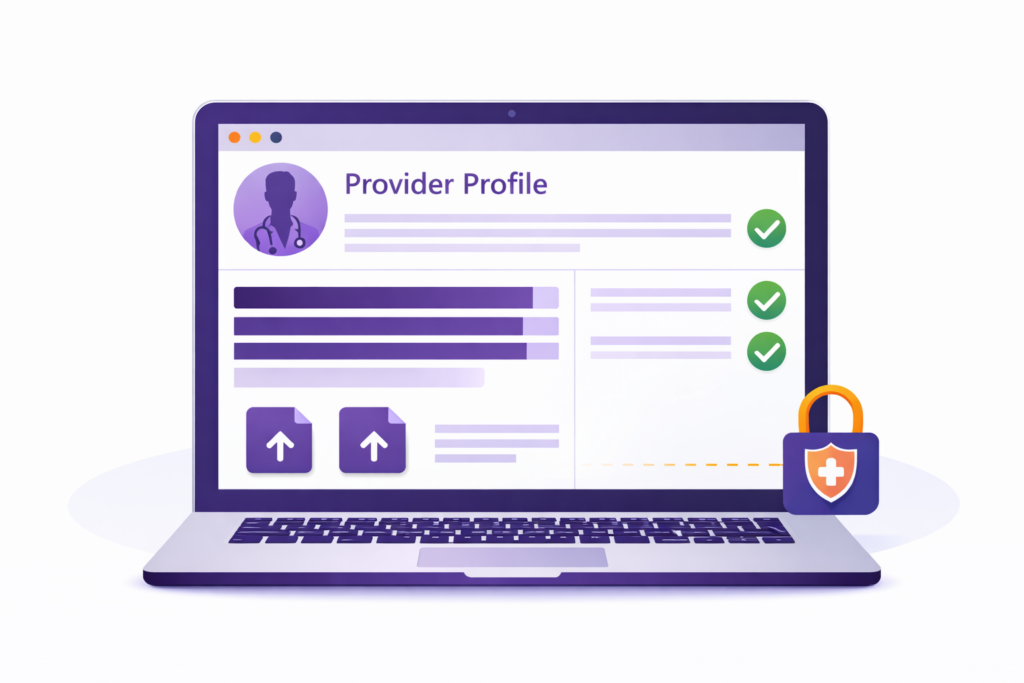
CAQH ProView is absolutely essential for dermatology credentialing. Over 1,400 insurance companies use it, and refusing to create a profile means you can’t credential with the vast majority of commercial payers.
Setting Up Your CAQH Profile for Dermatology
Step 1: Register at caqh.org Use your NPI to create your account. You’ll receive login credentials immediately.
Step 2: Complete every section thoroughly The dermatology-specific sections that trip people up:
- Specialty: Select “Dermatology” as primary
- Subspecialty: Add Mohs, cosmetic, dermatopathology if applicable
- Procedures: List specific procedures you perform (this affects payer contracts)
- Hospital privileges: Most dermatologists don’t have these—mark N/A clearly
Step 3: Upload supporting documents
- Medical license (PDF, current)
- Board certification (ABD certificate)
- Malpractice insurance (full face sheet, not just declarations page)
- Fellowship certificates if you have them
- Professional headshot (seriously, they require this)
Step 4: Attest your profile This is the step everyone forgets. Your CAQH profile isn’t active until you click “attest.” Payers can’t access your information otherwise.
Step 5: Re-attest every 120 days Set a calendar reminder. If your profile lapses, credentialing stops dead.
Common CAQH Mistakes Dermatologists Make
Listing too many procedures. Only list what you actually perform regularly. Over-listing can trigger additional verification requirements.
Incomplete work history. If you had a fellowship, it counts as employment. Don’t skip it.
Wrong insurance amounts. Your malpractice coverage must match what you uploaded. Discrepancies cause delays.
Forgetting to update when credentials change. License renewal? Board recertification? Update CAQH immediately.

Can a Dermatologist See Patients Before Credentialing Is Complete? (The Cash-Pay Option)
Yes, you can absolutely see patients before credentialing is complete, but there’s a catch: you can’t bill their insurance.
This means operating on a cash-pay or self-pay basis. For dermatologists, this is actually more viable than for some other specialties because you likely have a mix of insurance-covered and cosmetic services anyway.
Making Cash-Pay Work During Credentialing
Strategy 1: Focus on cosmetic procedures initially Botox, fillers, cosmetic laser treatments, and aesthetic services are typically self-pay regardless of credentialing status. You can generate revenue while waiting on insurance approvals.
Strategy 2: Offer discounted self-pay rates for medical services Some practices offer 30-40% discounts for patients paying cash for medical dermatology visits. This partially offsets the insurance reimbursement they’d normally get.
Strategy 3: Provide superbills for out-of-network reimbursement Even though you’re not credentialed, patients can submit superbills to their insurance for potential out-of-network reimbursement. You get paid immediately, they deal with their insurer.
Strategy 4: Screen for cash-pay friendly conditions Acne treatments, cosmetic consultations, and certain elective procedures attract patients more willing to pay out of pocket.
What You Absolutely Cannot Do
- Submit claims to insurance companies under your NPI
- Tell patients their insurance “will cover” services when you’re not credentialed
- Use another provider’s credentials to bill (this is fraud)
- Promise retroactive billing without confirming payer policy
The financial reality: Most dermatology practices can’t survive on cash-pay alone long-term. You need insurance credentialing to access the full patient market. Use cash-pay as a bridge, not a business model.
What Insurance Companies Require Dermatology Credentialing? (Basically All of Them)
If an insurance company covers dermatology services, they require credentialing. There are no shortcuts.
Major Commercial Payers Requiring Credentialing
National Carriers:
- Blue Cross Blue Shield (all state plans)
- UnitedHealthcare / Optum
- Aetna
- Cigna
- Humana
Regional and State-Specific Plans:
- Kaiser Permanente (CA, select states)
- Anthem (varies by state)
- Highmark (PA, WV, DE)
- Independence Blue Cross (PA)
- Florida Blue (FL)
- Texas Health Plans (TX)
Government Programs:
- Medicare (via PECOS enrollment)
- Medicaid (state-specific enrollment)
- Tricare (military families)
- VA (veterans)
Managed Care Organizations: Each commercial payer has multiple managed care subsidiaries. For example:
- UnitedHealthcare also includes United Behavioral Health, Oxford, etc.
- Aetna includes Coventry in some markets
- BCBS plans have dozens of subsidiaries
Payer-Specific Dermatology Requirements
Some insurers have specialty-specific quirks:
UnitedHealthcare is strict about malpractice insurance limits and requires higher coverage for surgical dermatology.
Aetna wants detailed procedure lists upfront and may credential you for medical derm but require separate approval for surgical procedures.
BCBS plans vary wildly by state—BCBS of California has completely different requirements than BCBS of Texas.
Medicare requires PECOS enrollment and has specific documentation requirements for in-office procedures and labs.
You’ll typically apply to 10-15 payers minimum to ensure adequate patient coverage in your area.
Does Medicare Require Separate Credentialing for Dermatologists? (Yes, Here’s How It Works)
Medicare enrollment is mandatory if you want to see Medicare patients—which, for dermatologists treating an aging population with increasing skin cancer rates, is basically non-negotiable.
Medicare Enrollment via PECOS
PECOS (Provider Enrollment, Chain and Ownership System) is where all Medicare credentialing happens for dermatologists.
What you’ll need:
- Completed CMS-855I application (individual enrollment)
- Valid state medical license
- Board certification in dermatology
- Practice location address
- Banking information for direct deposit
- Disclosure of ownership information
Timeline: 60-90 days typically, though complex applications or backlog periods can extend this.
Dermatology-specific considerations:
If you’re operating an in-office pathology lab, you need separate CLIA certification and may need CMS-855B (organizational enrollment) in addition to your individual enrollment.
If you’re performing Mohs surgery, ensure your facility meets Medicare requirements for surgical settings.
If you’re billing for advanced procedures like photodynamic therapy or extensive excisions, Medicare scrutinizes these more carefully during credentialing.
Medicare Advantage Plans
Here’s what confuses people: Medicare Advantage plans (Medicare Part C) require separate credentialing even though they’re Medicare programs.
Medicare Advantage is administered by commercial insurers (UnitedHealthcare, Humana, Aetna, etc.), so you need:
- Traditional Medicare enrollment via PECOS
- Separate credentialing with each Medicare Advantage carrier
This effectively doubles your credentialing workload for Medicare patients.
Medicaid Enrollment for Dermatologists
Medicaid is state-administered, so requirements vary dramatically. Some states dermatologists commonly practice in:
California (Medi-Cal): 90-120 days, requires additional state background checks, relatively comprehensive coverage of dermatology services
Texas (TMHP): 60-90 days, faster processing, but reimbursement rates are lower
Florida (AHCA): 90-120 days, separate AHCA registration required before Medicaid enrollment
New York (eMedNY): 90-150 days, notoriously slow, mandatory eMedNY enrollment
Illinois (HFS): 60-90 days, straightforward process
Many dermatologists skip Medicaid due to low reimbursement rates, but it can provide steady patient volume, especially for pediatric dermatology or medical dermatology in underserved areas.
Is Dermatology Credentialing Different from Enrollment? (Yes, Here’s the Distinction)
People use these terms interchangeably, but they’re actually sequential steps in getting you ready to bill insurance.
Credentialing = verification of your qualifications This is when the insurance company reviews your medical education, board certification, licenses, malpractice insurance, and background to determine if you meet their standards.
Enrollment = adding you to their provider network This happens after credentialing approval. The payer assigns you provider numbers, establishes your effective date, and enters you into their claims processing system.
How This Plays Out for Dermatologists
Step 1: You submit credentialing applications to payers Step 2: Payers verify your dermatology credentials (credentialing phase) Step 3: Once approved, payers process enrollment paperwork Step 4: You receive:
- Provider ID numbers
- Effective date (when you can start billing)
- Payer-specific billing guidelines
- Contract terms and reimbursement rates
Step 5: You can now submit claims
The gap between credentialing approval and enrollment completion can be 2-4 weeks. During this period, you’re approved but can’t bill yet.
Why This Matters for Cash Flow
You might get credentialing approval in Month 3, but if enrollment doesn’t finish until Month 4, you can’t submit claims until Month 4. Then factor in 30-45 days for claim processing, and you’re looking at Month 5 before revenue hits your account.
Understanding this distinction helps you plan cash flow more accurately.




















Can Credentialing Be Done for Multiple Dermatology Locations? (Yes, With Extra Steps)
Multi-location dermatology practices face compounded credentialing complexity. Each physical location where you see patients typically requires separate credentialing.
Multi-Location Credentialing Requirements
For each new office location, you’ll need:
- Site-specific application or amendment to existing credentialing
- Physical address verification (some payers require site inspections)
- Location-specific licensing if crossing state lines
- Updated CAQH profile with new practice addresses
- Separate provider numbers for each location with some payers
Timeline impact: Add 30-60 days per additional location. You can’t bill at the new location until that site is credentialed, even if you personally are already credentialed.
Cost consideration: Some credentialing services charge per location, others charge per provider. Clarify this upfront if you’re multi-site.
Tele-Dermatology Credentialing Services
Tele-dermatology adds another layer: multi-state licensing and credentialing.
The fundamental rule: You must be licensed in the state where your patient is physically located during the telehealth visit, not just where you’re sitting.
This means if you’re providing tele-dermatology across 5 states, you need:
- Medical licenses in all 5 states
- Credentialing with payers in all 5 states
- Compliance with each state’s telemedicine laws
- Separate Medicaid enrollment for each state
Interstate Medical Licensure Compact (IMLC) can expedite multi-state licensing for eligible dermatologists, but you still need separate credentialing in each state.
Payer telehealth policies vary wildly:
- Some require separate telehealth rider agreements
- Some credential telehealth under existing participation
- Some don’t cover dermatology via telehealth at all
- Some limit telehealth to established patients only
My recommendation for tele-derm: Start with 2-3 target states, get fully credentialed, then expand. Trying to credential in 10 states simultaneously is administrative chaos.
What Causes Delays in Dermatology Credentialing? (And How to Avoid Them)
Credentialing delays cost you thousands in lost revenue per week. Here are the specific issues that derail dermatology credentialing:
Delay #1: Incomplete CAQH Profile (2-4 week delay)
The problem: Missing sections, unattested profile, expired documents The fix: Complete every field, attest immediately, keep documents current
Delay #2: Malpractice Insurance Issues (2-6 week delay)
The problem: Coverage limits too low, wrong procedure categories, expired policies The fix: Verify your policy covers all dermatology procedures you perform (medical, surgical, cosmetic) and meets or exceeds $1M/$3M limits
Delay #3: Board Certification Verification (3-8 week delay)
The problem: ABD can’t verify your certification, or you’re not yet board-certified The fix: Ensure your ABD certification is current and verifiable. If you’re board-eligible but not certified, some payers won’t credential you—know this upfront
Delay #4: Missing Specialty Documentation (2-4 week delay)
The problem: Payers want Mohs fellowship certificates, laser training proof, or facility credentials you didn’t include The fix: Front-load all specialty documentation with your initial application
Delay #5: Address Inconsistencies (1-3 week delay)
The problem: Your practice address on your license doesn’t match CAQH or payer applications The fix: Ensure absolute consistency across all documents—same format, same suite number
Delay #6: Unresponsive References (2-4 week delay)
The problem: Payers can’t reach your references, or references don’t respond The fix: Choose dermatologist colleagues who respond quickly, give them a heads-up, confirm their contact info
Delay #7: Payer Backlogs (4-12 week delay)
The problem: Insurance companies are overwhelmed and processing slowly The fix: Submit during off-peak periods (avoid January and July), follow up weekly
Delay #8: State-Specific Medicaid Requirements (4-8 week delay)
The problem: Each state has unique requirements you didn’t anticipate The fix: Research state Medicaid requirements before applying, or use credentialing services that know state-specific rules
The single most important thing: Follow up religiously. Check application status every 7-10 days. Payers won’t chase you.
Should Dermatologists Outsource Credentialing Services? (Here’s My Honest Assessment)
You can handle dermatology credentialing yourself. You can also remove your own skin lesions, but you probably don’t.
When DIY Credentialing Makes Sense
You should consider handling it yourself if:
- You’re a solo dermatologist credentialing with 3-5 payers only
- You have dedicated administrative staff with credentialing experience
- You have 20+ hours to invest over 3-4 months
- You’re extremely organized and detail-oriented
- You don’t have time-sensitive opening deadlines
When Outsourcing Makes More Sense
Outsource if:
- You’re opening a new dermatology practice and need to hit the ground running
- You’re adding multiple providers to an existing practice
- You’re credentialing across multiple states
- You’re doing tele-dermatology requiring multi-state licensing
- You’re credentialing with 10+ payers
- You need Mohs surgery or dermatopathology credentialing
- You can’t afford 3-6 month delays
What Professional Dermatology Credentialing Services Provide
Complete application management where they handle every payer from start to finish
CAQH expertise including profile optimization for faster payer approval
Specialty-specific knowledge of dermatology requirements that generic services miss
Direct payer relationships that speed up verification and resolve issues faster
Proactive follow-up so you’re not chasing down applications yourself
Recredentialing management to prevent future network termination
Integration with billing ensuring claims can be submitted immediately upon approval
The Cost-Benefit Analysis
Typical outsourcing costs:
- $100-300 per provider per payer for initial credentialing
- $1,500-3,000 for comprehensive packages covering 10-15 payers
- Ongoing management: $100-200/month for recredentialing and compliance
Value calculation: If outsourcing saves you even 3-4 weeks per payer, and each week of delay costs you $7,000-12,000 in lost dermatology revenue, the ROI is massive.
A $2,500 investment in professional credentialing services easily pays for itself 5-10x over by eliminating delays.
My recommendation: For new dermatology practices or multi-provider groups, outsource. For established solo dermatologists adding one or two payers, you might DIY if you have the bandwidth. For anything involving Mohs, multiple locations, or telehealth, definitely outsource.

Frequently Asked Questions About Dermatology Credentialing Services
How much do dermatology credentialing services cost?
Dermatology credentialing services typically range from $100-300 per payer for individual applications, or $1,500-3,000 for comprehensive packages covering 10-15 major insurance companies. Ongoing recredentialing and compliance management runs $100-200 monthly. Some services charge per provider, while others charge per location. The investment is justified when you consider that credentialing delays cost $5,000-10,000+ per week in lost revenue. TrueCare RCM offers transparent pricing tailored to your practice size and needs—contact us at (323) 538-6467 for a customized quote.
How often do dermatologists need recredentialing?
Most insurance companies require dermatology provider recredentialing every 2-3 years to verify your credentials remain current. Medicare requires revalidation every 5 years through PECOS. Your CAQH profile requires re-attestation every 120 days (quarterly), though this isn’t full recredentialing—just confirmation your information is accurate. Missing recredentialing deadlines results in network termination, claim denials, and revenue disruption. Professional credentialing services track all revalidation dates and initiate recredentialing 3-6 months before deadlines, ensuring continuous network participation without lapses.
Is tele-dermatology credentialing different from in-person credentialing?
Yes, tele-dermatology credentialing is significantly more complex. You need medical licenses in every state where your patients are located, not just where you practice. This requires separate state licensing, credentialing with payers in each state, and Medicaid enrollment per state if applicable. Some insurers require telehealth-specific rider agreements or amendments to participation contracts. Coverage policies vary—some payers limit telehealth to established patients or specific diagnosis codes. The Interstate Medical Licensure Compact (IMLC) can expedite multi-state licensing for eligible dermatologists, but each state still requires individual payer credentialing. Professional credentialing services experienced in telehealth can navigate these multi-state requirements efficiently.
Can claims be billed retroactively after dermatology credentialing approval?
Retroactive billing policies vary by payer. Some commercial insurers allow retroactive billing back to your application submission date, typically 30-90 days. Others only honor claims from your effective date forward. Medicare generally does not permit retroactive billing beyond your PECOS enrollment effective date. Medicaid policies vary by state—some allow limited retroactive coverage. Always ask about retroactive billing policies when submitting applications and document all services provided during credentialing in case retroactive billing is approved. If you see patients before credentialing completes, inform them claims may not be billable unless the payer approves retroactive billing.
What happens if a dermatology credentialing application is denied?
Denials are uncommon for qualified dermatologists but occur due to incomplete applications, expired documents, or professional history issues. Request detailed denial explanations from the payer immediately. Most denials can be appealed within 30-60 days by providing additional documentation or clarification. Common fixable issues include missing Mohs fellowship verification, malpractice coverage gaps, or CAQH profile errors. Professional credentialing services excel at appeals, knowing exactly what documentation payers need. If denial stems from disciplinary actions or malpractice history, you may need legal consultation. For application errors, simply correct and resubmit—professional services prevent these issues upfront.
Do cosmetic dermatology procedures require separate credentialing?
Cosmetic dermatology procedures (Botox, fillers, laser aesthetics) typically don’t require separate insurance credentialing because they’re not covered by insurance—they’re self-pay services. However, some dermatologists offering both medical and cosmetic services need clear delineation in their payer contracts about which procedures are insurance-billable versus cash-pay. If you perform medical procedures that have cosmetic applications (like laser treatment for rosacea vs. cosmetic laser), payers may scrutinize these more carefully. Ensure your credentialing application accurately reflects your scope of practice. Malpractice insurance must cover all procedures you perform, including cosmetic work, which sometimes requires higher limits or specific endorsements.
Can dermatologists credential with Medicare Advantage plans separately from traditional Medicare?
Yes, and you must. Traditional Medicare requires PECOS enrollment, which credentials you with CMS. Medicare Advantage plans (Medicare Part C) are administered by commercial insurers like UnitedHealthcare, Humana, and Aetna, so they require separate credentialing with each carrier. This means a dermatologist needs both PECOS enrollment for traditional Medicare patients AND individual credentialing with each Medicare Advantage plan to maximize patient access. This effectively doubles your Medicare credentialing workload. Each Medicare Advantage plan has different reimbursement rates and participation requirements, so you can choose which plans to join based on patient demographics in your area.
How does credentialing affect a dermatology practice’s revenue cycle?
Credentialing directly determines when your practice can begin generating insurance revenue. Without completed credentialing, claims are rejected, creating a cash flow gap of 3-6 months for new practices. Even after credentialing completes, claims processing adds 30-45 days before payment arrives. This means new dermatology practices need 6-8 months operating capital minimum. Credentialing delays compound the problem—each month of delay costs $15,000-30,000+ in lost revenue for a typical dermatology practice. Professional credentialing services integrate with your billing setup, ensuring claims can be submitted immediately upon credentialing approval, maximizing revenue cycle efficiency and minimizing cash flow disruption.
Ready to Get Your Dermatology Practice Credentialed and Billing?
Dermatology credentialing doesn’t have to derail your practice launch or expansion. With the right expertise handling your applications, you’ll be seeing insured patients and generating revenue in 90-120 days instead of fighting delays for 6+ months.
TrueCare RCM specializes in dermatology credentialing services across all 50 states, with deep expertise in medical dermatology, Mohs surgery, dermatopathology, and tele-dermatology credentialing. We’ve credentialed hundreds of dermatologists and know exactly how to navigate payer-specific requirements for your specialty.
Our comprehensive dermatology credentialing services include:
- Complete CAQH profile setup and maintenance
- Medicare PECOS and Medicaid enrollment
- Commercial payer credentialing (BCBS, Aetna, Cigna, UnitedHealthcare, Humana, and more)
- Multi-location and multi-state credentialing
- Mohs surgery and dermatopathology specialty credentialing
- Recredentialing and compliance management
- Integration with medical billing for seamless claims submission
Serving dermatologists nationwide, with specialty expertise in:
California | Texas | Florida | New York | Illinois | Michigan | Georgia | Maryland